Showing posts with label scientific method. Show all posts

Wednesday, 29 July 2009

Solidarity

My apologies for the long delay in posting and the dearth of new material on this post. All I can do is assure you that I am still alive, but merely very busy with my PhD and a publication... Today sciencey and not so sciencey blogs across the web are re-publishing an article by Simon Singh about the many dubious claims of chiropractors and the British Chiropractic Association in particular. I have made reference to some of the poorly-supported claims of the BCA in a previous blog entry. I've also discussed how scientists go about refuting dubious claims. Science is an adversarial system in which our claims and the evidence upon which they are based are subjected to close scrutiny and, if they appear weak, are attacked. We debate, we refute with contradictory evidence, we put forward alternative explanations for the observable facts. We do not litigate, because litigation silences a scientific debate and transfers it into a courtroom so that some lawyers can have a financially ruinous legal debate.

But the BCA sees things differently. When last year Simon Singh pointed out how weak the evidence in support of chiropractic really is, the BCA reacted not with scientific evidence, nor logical argument. They sued him. That action is now ongoing and has been commented on by Bad Science. For science to progress, debate must be free and open and won on the basis of evidence, not legal funds. This is especially important when it comes to health, because when debate about medical science is stifled, bad practices persist and the outcome is suffering and death. Whether chiropractic is effective and safe will never be determined by a judge. If any of this bothers you sufficiently, the British organisation Sense About Science have a petition you can sign.

The original Singh article (modified to avoid the BCA's litigation bat) is reproduced below, as it has been reproduced by Sharon at The Voyage, Pharyngula and many other blogs. Feel free to refute it with scientific evidence!

Beware the spinal trap

Some practitioners claim it is a cure-all, but the research suggests chiropractic therapy has mixed results - and can even be lethal, says Simon Singh.

You might be surprised to know that the founder of chiropractic therapy, Daniel David Palmer, wrote that "99% of all diseases are caused by displaced vertebrae". In the 1860s, Palmer began to develop his theory that the spine was involved in almost every illness because the spinal cord connects the brain to the rest of the body. Therefore any misalignment could cause a problem in distant parts of the body.

In fact, Palmer's first chiropractic intervention supposedly cured a man who had been profoundly deaf for 17 years. His second treatment was equally strange, because he claimed that he treated a patient with heart trouble by correcting a displaced vertebra.

You might think that modern chiropractors restrict themselves to treating back problems, but in fact some still possess quite wacky ideas. The fundamentalists argue that they can cure anything, including helping treat children with colic, sleeping and feeding problems, frequent ear infections, asthma and prolonged crying - even though there is not a jot of evidence.

I can confidently label these assertions as utter nonsense because I have co-authored a book about alternative medicine with the world's first professor of complementary medicine, Edzard Ernst. He learned chiropractic techniques himself and used them as a doctor. This is when he began to see the need for some critical evaluation. Among other projects, he examined the evidence from 70 trials exploring the benefits of chiropractic therapy in conditions unrelated to the back. He found no evidence to suggest that chiropractors could treat any such conditions.

But what about chiropractic in the context of treating back problems? Manipulating the spine can cure some problems, but results are mixed. To be fair, conventional approaches, such as physiotherapy, also struggle to treat back problems with any consistency. Nevertheless, conventional therapy is still preferable because of the serious dangers associated with chiropractic.

In 2001, a systematic review of five studies revealed that roughly half of all chiropractic patients experience temporary adverse effects, such as pain, numbness, stiffness, dizziness and headaches. These are relatively minor effects, but the frequency is very high, and this has to be weighed against the limited benefit offered by chiropractors.

More worryingly, the hallmark technique of the chiropractor, known as high-velocity, low-amplitude thrust, carries much more significant risks. This involves pushing joints beyond their natural range of motion by applying a short, sharp force. Although this is a safe procedure for most patients, others can suffer dislocations and fractures.

Worse still, manipulation of the neck can damage the vertebral arteries, which supply blood to the brain. So-called vertebral dissection can ultimately cut off the blood supply, which in turn can lead to a stroke and even death. Because there is usually a delay between the vertebral dissection and the blockage of blood to the brain, the link between chiropractic and strokes went unnoticed for many years. Recently, however, it has been possible to identify cases where spinal manipulation has certainly been the cause of vertebral dissection.

Laurie Mathiason was a 20-year-old Canadian waitress who visited a chiropractor 21 times between 1997 and 1998 to relieve her low-back pain. On her penultimate visit she complained of stiffness in her neck. That evening she began dropping plates at the restaurant, so she returned to the chiropractor. As the chiropractor manipulated her neck, Mathiason began to cry, her eyes started to roll, she foamed at the mouth and her body began to convulse. She was rushed to hospital, slipped into a coma and died three days later. At the inquest, the coroner declared: "Laurie died of a ruptured vertebral artery, which occurred in association with a chiropractic manipulation of the neck."

This case is not unique. In Canada alone there have been several other women who have died after receiving chiropractic therapy, and Edzard Ernst has identified about 700 cases of serious complications among the medical literature. This should be a major concern for health officials, particularly as under-reporting will mean that the actual number of cases is much higher.

If spinal manipulation were a drug with such serious adverse effects and so little demonstrable benefit, then it would almost certainly have been taken off the market.

Thursday, 12 February 2009

Happy Darwin Day

Happy Darwin Day! Today we celebrate the 200th birthday of a scientific revolutionary. Like Pasteur, Mendel, Newton and Einstein, Darwin ushered in a shift in our perception of the evidence. In Darwin's lifetime the nature of life and its place in the world was explained by a mixture of assumption and religion. The science that existed was disparate. Biologists were just starting to understand heredity and variation. That variation displayed such great diversity at times, and yet such curious similarities. The distribution seemed to make little sense. Geologists were pointing to the massively stratified nature of their favourite medium (rock) as evidence that the world was far older than they had expected and wondered at the curious sequence of petrified organic structures they found within. Layer upon layer, that same progression across every strata and every geological discontinuity, across the world. The evidence was all there, merely waiting for someone to bring it together into one clear picture.

In November, we'll celebrate the 150th anniversary of the publication of that clear picture. Darwin's most prominent work, On the Origin of Species. Just as Newton's world was superceded, but not destroyed, by Einstein's; so too has Darwin's work found itself but a small part of a grander theory. His Laws of Natural Selection remain intact, his notions on heredity and genetics superceded by his contemporary Mendel. Both now standing along side the molecular genetics of Watson, Crick and Franklin.

There are those who say that scientists hold Darwin sacred. That his theory has become dogma. But it is likely that if Darwin read a modern biology textbook today, he would certainly disagree. He might even be a little annoyed at the absence of some of his hypotheses. But he would be delighted that natural selection has endured so well. And delighted that humanity has cast aside the notions of racial species divides which he loathed so much.

He gave us a part of the picture. We have accepted those ideas of his which have been borne out in experimentation, and discarded those which did not. Concepts that brought the evidence together in a revolutionary way. He was the first to understand our true nature and our place in the world. For that, we celebrate a great man and a scientist who stands as an example of dedication and remarkable insight.

Happy Birthday Charlie.

Wednesday, 4 February 2009

Accept Evolution, Eat People

During the weekend Donna Garner, a former language arts teacher in Central Texas and a conservative activist, circulated an email in response to the recent move by the Texas State Board of Education to close a long-standing loophole in their policy on the teaching of science. Previously, it was a requirement to debate the "strengths and weaknesses" of the theory of Evolution (or any scientific theory). A requirement, even if the matter was not prompted by students. In practise, this has been used as a back door to introduce creationist and intelligent design arguments into the classroom. Not actual scientific weaknesses, but religious criticisms. Science is not debated in terms of strengths and weaknesses, but in terms of evidence. But I'll return to that point.

She begins:

Dear Friends of Students:

This year, 2009, is the 200th anniversary of the birth of Charles Darwin (born in 1809), author of Origin of the Species. Atheist groups across America are using this anniversary to move aggressively to force all 50 million public school students to be taught that macro-evolution (life spontaneously springing from a chemical reaction with all life stemming from that common chemical reaction and becoming different species through mutations) is a fact–without allowing the teaching or discussion of the scientific “weaknesses” increasingly being discovered concerning the theory of evolution. Texas, with its 4.7 million students, was selected as the first state to conquer. And, so far, the atheists are winning in Texas.

Let's just take a look at what has been said and left unsaid in her opening statements.

Garner immediately puts a suggestion into our minds without backing it up. "Atheist groups are using this...", "the atheists are winning". Immediately the subject is not education, but religion. In her mind (and she wants us to join her there), this is not about science, but faith. No names are named, no figures cited. We are to assume that science advocacy groups such as Texas Citizens for Science, The Texas Freedom Network and countless others are atheistic in nature. The atheists are doing this, and presumably it's part of a grand plan. A war to be won at terrible cost to you the reader, a cost to be outlined later.

Next she both introduces and defines "macro-evolution" and states that everyone will be forced to learn this thing that she has defined as fact. Macro-evolution is a term not used in the scientific literature or in text books, so it is good that Garner defines it for us. But her definition does not actually match up with anything taught in US schools. Her target, Evolution, does not attempt to explain the origins of life itself (which are not conclusively known) but merely the origin of the great variety of life that we now see. That origin is indeed a common ancestor, but for now at least, Garner's "spontaneous springing [of life] from a chemical reaction" remains within the realms of hypothesis. If it is taught at all, it is taught in that context. Macro evolution then, is something of a Straw Man.

Finally, she implies that Evolution has "scientific weaknesses" that are, she says "increasingly being discovered". Well I'm quite sure that evolution does have flaws, but with what relevance to high school students? With what support within the expert community? If a fringe group of historians contend that Abraham Lincoln's murder was motivated by Wilkes-Booth's phobia of beards (or something more plausible perhaps) we're not going to open up the floor for students to specifically "debate the weaknesses" in the theory that the assassination was politically motivated. This is not an end to questions about the motive or the politics which formed it, but the dishonest notion that a meaningful debate exists in the field is not entertained. And of course, the curriculum for a given subject should reflect the consensus of the relevant experts.

As for weaknesses "increasingly being discovered", well there's certainly nothing new in the pseudoscience that Ms. Garner will shortly inflict on us.

Let's move on.

For more than 20 years, the rule in Texas has been to teach both the “strengths and weaknesses” of evolution. Last week, by a margin of 1 vote, the Texas State Board of Education voted to remove the word “weaknesses” so that only the strengths of evolution could be “analyzed and evaluated” in all Texas public schools. The final vote is in March, so there is time to make a difference.

As I indicated previously, the "strengths-versus-weakness" model of debate or analysis is a curious idea, and it is not really one which applies to science, assuming we are seeking to invite serious debate in a classroom. If evolution is open to being "analysed and evaluated" (and of course it is), it stands to reason that this should be on the basis of evidence.

Some evidence will support evolution and some, if evolution is incorrect, will contradict it. The thing about scientific theories is that we do not weigh-up the "pros and cons" of a theory when deciding if it is legitimate. If one piece of evidence contradicts the predictions of a theory (and it can be shown that the evidence is real and reproducible), then the theory is dead. Totally dead. No balancing of strengths or weaknesses. The theory is in the bin and we have to build a new one. One piece of falsifying evidence automatically outweighs all the "strengths" we could care to present.

The strengths and weaknesses method of debating science is perhaps a reflection of a science curriculum that does not address how hypotheses, evidence and theories are constructed in science. Or perhaps it is a back door designed to allow spurious attack upon theories which are seen to contradict an agenda.

Garner then lists who voted on the new wording and how, providing contact details for each so that we can phone up and demand that somebody think of the children. I'll cut this on the basis of it also being really boring.

*Snip*

Garner continues with an attempt to make "the atheists" look like hypocrites. After all, everyone knows that if you're a hypocrite, you're wrong about everything, right? Ad hominem much?

Charles Darwin, in Origin of the Species said the following concerning the proper evaluation of his theory: “A fair result can be obtained only by fully stating and balancing the facts on both sides of each question.” Too bad Darwin wasn’t on the State Board of Education to vote to keep “weaknesses” in.

Darwin, of course, was stating the obvious. That we must consider all the evidence before making a decision about something. Ms. Garner won't like to admit it, but Evolution was accepted by scientific consensus by this very means a very long time ago. Debate over the course of some decades by the finest minds in science.

In a pedantic point, Darwin's book was not called "Origin of the Species" but "On the Origin of Species", being as it is a work explaining the emergence of species plural. You'll also note that it is not called "On the Origin of Life", and thus must not have anything to do with Garner's proposed "macro-evolution".

At least, he was intellectually honest about his theory.

Ah, "at least". Suggestion once again. He wasn't honest about everything. This casts doubt on evolution. Painful.

He recognized that science advances by constantly probing and questioning, not by censorship, intimidation, or indoctrination.

Are we talking about the advancement of science? I'm quite sure that Darwin would also have recognised that continuing to debate a scientific theory 100 years after it has come to be considered accurate by scientists is rather counter-productive. But that is not even the issue here. Whilst we should certainly teach our children about gravity, it wouldn't exactly be "scientific" to perpetuate a debate on the matter on the basis that we should never stop questioning. We never do stop questioning these theories, but what Ms. Garner has failed to grasp is the nature of that questioning. Scientific research. Experimentation. Not debate in a room full of teenagers. How would such a debate advance science or some other subject such as history?

We have debate in the public between creationists and evolutionists, although that debate is painted as a scientific one, the matter has already been resolved in the scientific community for some 100 years or more. Finally, we have debates like these. The reader can see Ms. Garner's side, and the side of people such as me. So it doesn't really look like anyone is pulling off the censorship routine. Or at least not doing it well. So I'm sure Darwin would be more than satisfied (well of course I'm not sure, I never knew the guy and neither did Ms. Garner). The question that remains is whether that debate has any place in the class room.

The 3 Republicans don’t seem to get it. They want to water down the current standard to eliminate any airing of “weaknesses” by eliminating the word “weaknesses.” The battle is over that one word. It needs to be there. As a lawyer, I know more than most that words are important. So don’t be fooled, the retention of the word is worth all of us fighting for.

Again, the "strengths versus weaknesses" model of assessment does not really work for science and really should be scrapped entirely in favour of teaching kids how to assess scientific evidence, form and test hypotheses and build theories.

Garner then decides to elaborate further on her definition of Evolution. In doing so, she describes a theory that only appears in one kind of text book or scholarly publication anywhere: creationist ones.

Short primer on evolution: In describing evolution, there are 2 catagories: (1) Micro-evolution, and (2) Macro-evolution. Micro-evolution (small changes over time within the same species) is something we can observe today (bugs become resistant to drugs; birds beaks grow longer, moths change colors).

Biologists make no such distinction, and for a very good reason. There are no differences in the underlying mechanisms that drive the micro or the macro. Evolution is driven by replication, mutation, genetic drift, natural selection, gene transfer. Ask creationists what micro-evolution is driven by and they'll give the same answer. So it's rather like making a distinction between taking a walk in your garden (by using the easily provable micro-walking) versus going down to the shops (which would require the obviously impossible macro-walking).

If we're agreed that some evolution can generate some variation, then why can we not agree that more evolution can generate more variation?

But Garner has evidence that there's a difference between the macro and the mirco.

I personally think it makes perfect sense that a good Designer would design each creature with built-in abilities to adapt to survive. But the debate before the Board is not over micro-evolution, but over the teaching of macro-evolution. We have never observed one species becoming a different species (macro-evolution).

In fact, we have observed species become a different species quite a number of times both in the lab and in the wild. Some nice (but not at all exhaustive) examples of these are detailed at the following links:

http://www.talkorigins.org/faqs/faq-speciation.html
http://www.talkorigins.org/faqs/speciation.html

But on to more "evidence". Am I using sarcastic quotes too much?

And we have never observed how life began.

Indeed we have not, but then we don't teach highschool kids how life began. We don't teach abiogenesis as fact to anyone at all. It's not a part of the theory of evolution at this time and won't be until that evidence is in. At this time, the origin of life is rather irrelevant to the debate.

This is where we need to examine the scientific strengths and weaknesses. And with respect to macro-evolution there are numerous scientific weaknesses, to name a few: (1) the Cambrian explosion of life; (2) gaps in the fossil record; (3) the intractable origin of life chemistry problems; (4) the origin of information in the DNA molecule; and (5) irreducibly complex features. Honest scientists acknowledge these and other weaknesses—but atheists don’t want these weaknesses highlighted—particularly not to our children. This is the Scopes Monkey Trial in reverse.

It would take another blog post in itself to fully refute the five points outlined here. They are classic cliches, and nothing new at all. But briefly, number 1 is something of a mystery. That is to say, I have little idea what Garner is getting at and it's unlikely that she does either (I have seen one argument regarding the Cambrian Explosion used by creationists, but that argument was dropped some years ago when it was mysteriously removed from the creationist website that had hosted it). Number 2 represents limitations to our knowledge. I think we can safely say that were there no gaps in our observations, we would have little need for theory (or religion) and science itself would become a job dedicated to teaching rather than research. If the reader has been following closely, we can of course immediately dismiss number 3 as having exactly nothing to do with how evolution is taught. Number 4 is in a similar vein since it deals with events prior to the origins of life and with concepts of "information" that are perhaps rather beyond a high school class. Number 5 is a topic I've already made a nonsense of here.

She concludes her list of "weaknesses" by claiming that "honest scientists" acknowledge these issues. Certainly, mainstream biologists don't assume that abiogenesis is an answered question, but they also don't consider it a part of theory. The vast majority of biologists, and the scientific community at large, consider evolution accurate. Just as consensus determined by historians informs the history syllabus, so too does the scientific consensus inform the scientific syllabus. What Garner of course means by "honest scientists" is creationists and intelligent design proponents. What "atheists" refers to here is not clear, but is presumably "everyone else" including the scientific community and all of the science advocacy groups. And the Catholic Church. Hmm...

Because their fields are a pseudoscience (as distinct from a fringe science), these people are considered to be scientists only by themselves. But what if we decided to include creationists and intelligent design proponents in our definition of the scientific community? Would evolution remain accepted by consensus? Are scientists redrawing the lines of the definition of "scientist" so that they can maintain an artificial consensus?

In terms of raw numbers of people, it's hard to assess just how many creationists are active in research. Newsweek puts the figure at approximately 700 in the United States. There are 480,000 life scientists in the United States, and evolution also is accepted by the overwhelming majority of scientists in the physical sciences, an even larger group. Not to mention almost universal support in scientific communities across the world. Let us generously suppose then that we are talking about 2000 creation scientists in a worldwide community of just 1 million biologists and geologists. 0.2% of a community does not break a consensus. So even if we include creationists in the scientific community the consensus, unsurprisingly, remains that evolution is valid and thus it should be taught as valid.

The "scientific debate" is a fabrication. To the scientific community, it is a (scientifically) small and illogical tantrum. It is only in the public eye that the debate has any validity or support at all. And the bulk of creationist efforts are bent towards increasing that validity. We need only look at the publication patterns of the creationists to see evidence of this. They produce little original research, preferring instead to publish essays and glossy text books. In 2008 alone, biologists published over 3000 research papers with the word "evolution" in the title (plus over 400 reviews, an unknown number of essays and textbooks). We can assume that there were many more on the topic of course, since most papers would not mention such a broad topic as evolution in their titles. It would greatly surprise me if the various creationist communities combined have managed to publish 3000 research papers in the last 20 years. Or even an output of research comparable to their small size. This is not reflection of general poor output or funding,creation advocacy groups generate plenty of essays and command tens of millions of dollars annually. Propaganda is the priority, not science.

Ms. Garner has one more shot to fire. The cost. The terrible danger that exists if we do not allow the Creation Tantrum to be given the validity of discussion in the classroom. The cost of accepting that evolution is both a valid theory and a reflection of fact.

Thus she concludes:

Jeffrey Dahmer, one of America’s most infamous serial killers who cannibalized more than 17 boys before being captured, gave an last interview with Dateline NBC nine months before his death, and he said the following about why he acted as he did: “If a person doesn’t think that there is a God to be accountable to, then what’s the point of trying to modify your behavior to keep it within acceptable ranges? That’s how I thought anyway. I always believed the theory of evolution as truth, that we all just came from the slime. When we died, you know, that was it, there was nothing….” (Dateline NBC, The Final Interview, Nov. 29, 1994).

The implication is clear. Evolution is part of a nihilistic and atheistic attack on religion. It leads to more atheism. And atheism leads to cannibalism (oh okay, at least to immorality). And the moral expert she cites to both imply and support this? A serial killer and cannibal. It makes my mind sore.

Will evolution kill faith? The Catholic Church seems to think not. The 1 billion Christians who follow that church seem to have no issue accepting evolution and their faith side by side. Evolution only poses a threat to Christian faiths which consider the book of Genesis to be a literal account of Creation. And that by no means assures that those who lose their faith in that literal truth are destined to become atheists. And what if they do become atheists? It is, of course, utterly unsurprising that someone like Dahmer could only build morality on the basis of personal consequence meted out by authority. He was a psychopath. He did not value human life in itself.

If the punishment of God is all that keeps Ms. Garner from killing and eating people, then I do hope she retains her faith. But I suspect that this is not the case. There is, in truth, no evidence at all that atheists are less moral on average than Christians. But we're rather getting away from the point, which is that the path from evolution to people-eating is a fantasy. One dreamed up by people who seem to think that morality is a very thin veil, a tenuous construction drawn over the amoral animal that is man. And held in place only by the ten commandments. I do wonder how strong the faith of the Creationists must be if they really see science, the simple observation of nature, as this manner of threat. But certainly, a little more faith in people is sorely needed.

Tuesday, 2 December 2008

Hypothesis, theory and fact: First Assumptions Part 2

I said I'd write something about conferences and fashionable science, but it didn't come. Until it does, here's something else I'm toying with.

"All perception of truth is the detection of an analogy." -Thoreau

In my first post to this blog I discussed the meaning of the scientific concepts of hypothesis and theory. I highlighted how the public tend to think of “theory” in the same way that scientists think of hypothesis, in other words as an idea or educated guess. In fact theory is a word we use to describe the scientific models that we have the utmost confidence in. I’d like to elaborate a little on the concepts of hypothesis and theory and how they relate to what we call reality or fact.

All of science begins with observation. We sample the world and derive data from it. We can make data from all sorts of measurements, indeed from literally anything we can observe and measure. We might be measuring the height of people, the amount of heat produced by chemical reactions or counting the number of bacteria on people’s coffee mugs.

Analogy time

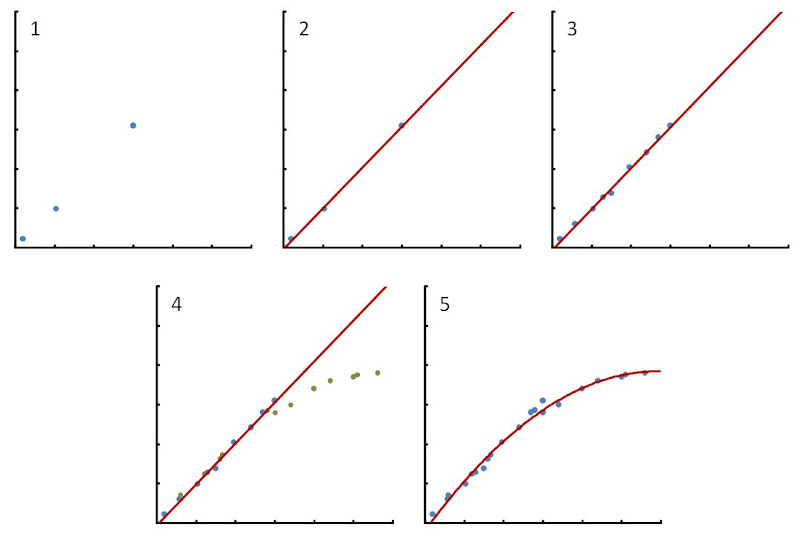
Let’s consider a simplified and slightly unrealistic analogy. First, we’ll pretend that we know very little about the subject of the study we’re about to do; people. Perhaps we’re aliens (or just really antisocial) but we don’t know much about people and we want to find out more. We’re most interested in the relationship between the size of people and how old they are. So we plan to measure the height of people and their age and plot this data on a graph called a scatter plot. Every person we measure appears as a blue dot. The higher up the graph they are, the taller we’ve measured them to be. The older they are, the further to the right they’ll be.


When we first begin to measure a thing, it can be difficult for us to determine if there are any patterns in the data, any meaning to be found. Look at graph 1. We antisocial scientists have made our first few measurements. Although it is far too soon to be confident that there’s a pattern here, it looks a bit like there’s a relationship between height and age in humans.

So we can create our first hypothesis. In graph number 2, we create a line which joins the data points together and also projects beyond them. We’re assuming that the relationship will hold for all people we measure, just for the moment. Just to make it sound important, we call our new hypothesis the Linear Growth Model or LGM (scientists love acronyms). The line is the hypothesis, a provisional model that we’ll cautiously use as a starting point. Put into words, the hypothesis would state: there is a linear relationship between the height of people and their ages. A statement of fact that we can now test.

The LGM is a good scientific hypothesis for that one important reason; it makes predictions that we can test. If the Linear Growth hypothesis is correct, then we expect that when we make more observations, they’ll appear on or near to our line. The scientific philosopher Karl Popper considered one other feature to be essential for a hypothesis to be valid; falsifiability, the possibility that our hypothesis can be shown to be incorrect by testing. At this early stage, our hypothesis could be falsified by finding just a few data points that fall far from out trend line. So of course we further test our model, measuring more heights and more ages. And when we look at graph 3, it seems we’re on to something! At this point it’s worth mentioning error. Measurements may often be subject to error. When measuring height, we might make a mistake. Or the height for people of the same age may vary (we know that it does of course, but for the purposes of our analogy let’s play dumb). So we often make the same measurement numerous times, or test many people of the same age. What we’ve done is measure our uncertainty and we can represent that uncertainty by drawing error bars that come out of each data point. We won’t worry about this further, but the point is that even though our data points may not exactly land on the red line, we are satisfied as long as the line passes through the area of error that lies around the data point.

With more and more data collected, our imaginary scientific colleagues now accept the Linear Growth Model as a satisfactory and useful model. It has become the Theory of Linear Growth. However, as often happens in science, it turns out that our theory is not entirely accurate. We realise that we’ve been building our model, the line, based on a very narrow data set. Because if you recall, we’re not all that familiar with how people work. And what we’ve gone and done is only measure the humans hanging around a playground. Some bright spark twigs that humans have loads of other habitats we didn’t observe. But maybe it’ll be okay, let’s find out. If the theory of Linear Growth is universally correct, then any new data points we get should continue to fit on our line. Of course we can see where this is going now, but let’s play dumb and continue.

When we extend our observations to older and older people, we start to see some data points that don’t fit our model at all. Had we seen these first few contradictory data points back at the start, it might have immediately caused us to discard our hypothesis before it even became theory. But with so much data in support of the theory, a few pieces of data are not sufficient for us to throw out the Linear Growth theory at the drop of a hat. As the saying goes, extraordinary claims require extraordinary evidence. But as we make more observations, the evidence becomes more compelling. In graph 4 it finally becomes clear to us that our theory has been falsified by the new data points shown in green. Too much of that data does not fit our model and thus we can no longer say that it represents fact.

Revolution!

So it turns out our old model doesn’t really work. But all is not lost. With our new data we can create firstly a new hypothesis and, in time, a new theory. In graph number 5 we see a curved red line that is the new Growth Plateau Model, a more comprehensive development of the now discarded Linear Growth Model. And so the old theory must be put aside- it serves as a model for the growth of children but is not useful outside of that context.

Our brand new Growth Plateau Model is testable and it has predictive power. We’re not concerned about gaps between the data points, because gaps do not falsify a model- contradictory data does. Were we to find many data points far from our line, we’d know our model was not accurate, assuming this was not explainable by some other means. But as the data keeps coming in, we find that the model holds for every observation.

Of course, hypothesis and theory aren’t strictly about scatter plots and trend lines. But this serves well as an analogy for how the process really works in science. Real hypotheses may be just as simple as that single statement about the linear relationship between aging and height. Theories however, are typically built from the combination of many hypotheses and unlike our analogy; they must not only have predictive power but also have explanatory power. We must be able to test the mechanisms that underlie the relationships we’ve modelled. But that concept of modelling reality, of joining the dots between our observations and testing that model, is fundamental to science. Just as fundamental is the moment we falsify our model and thus discard it. It is this moment, in which we build a new model upon the data, which sets science apart from dogma, in which no change is permissible, and diagnosis, in which we attempt to fit the data to various pre-determined models. Sometimes, as we saw with the Linear Growth Model, we don’t need to discard the old model, as in essence it becomes a small part of a bigger model and can still be useful in a limited way. In real science we can see many examples of this sort of “re-framing” of a theory rather than outright scientific revolution. For instance, although we’ve since come to understand modern genetics, the processes of variation and natural selection explained by Darwin are still a part of the modern theory of evolution. Similarly, the rise of Einstein highlighted the shortcomings of the Newtonian explanation of gravity, but we still use Newton’s laws for many simple applications. These theories, and indeed all good theories, share the predictive power of our made-up theory. Evolutionary theory allows us to predict what we’ll find in the fossil record and the genetic codes of organisms, and provides an explanation for those findings. To date, it has not failed us in either regard. Relativity explained peculiarities in the orbit of the planet Mercury and predicted strange effects of high speed upon the flow of time that would later be observed in experiments. So we can have great confidence that the untested predictions of these theories are accurate, that our models represent fact.

Tuesday, 21 October 2008

Moronic Design

November of next year brings to us biology-types, and to all of the scientifically-minded, a very special anniversary. It will mark the 150th year since the publication of what is certainly the most significant scientific work in the field of biology and one which would easily make the top three across the entirety of science. The publication in question is of course Charles Darwin’s “On the Origin of Species”. In it, Darwin laid out his case for his hypothesis on, as the title suggests, the origins of the variety (and similarity) we see between the many species of our planet.

The theory states the following. A common ancestor species once existed which produced offspring. As new generations of offspring were produced, inheritable differences (variations) began to appear in them. Some variations produced a benefit, others did not. Those variations that were beneficial enhanced the survival of the altered offspring and so those new traits were more likely to be passed on. The detrimental variations, whilst not always fatal, were less likely to be passed on simply because they reduced the carriers’ chances of survival and reproduction. Thus we have three simple mechanisms; reproduction, variation and selection. Add enough time, changing environments, migrations, separations and countless other influences and you get groups of organisms that have changed so much that they can no longer interbreed. These are broadly called species. So when you have these mechanisms working across an entire planet for over 3 billion years, you get a whole lot of species. I covered this whole process in a whimsical little story, posted a couple of months ago.

The scientific crisis and revolution that followed lasted decades, and was mostly heralded by Darwin’s supporters, rather than the man himself. His book and the works which confirmed his observations made a compelling case, and 150 years later his theory of evolution is accepted as the standing model of how life on Earth derived from a common ancestor. It is a theory that is so simple to explain that it is often described by scientists of all fields as “elegant” or even “beautiful”.

You may recall my explanation of how scientists develop a hypothesis, a testable idea, and then make observations and measurements that have the potential to disprove the hypothesis. If the hypothesis survives many observations, can be shown to predict bits we haven’t looked at yet, and can be confirmed independently, it becomes theory. A theory is the currently accepted model. That’s an important definition, because in common language “theory” generally has a meaning more like what scientists call a “hypothesis”. So when say, a creationist calls evolution “just a theory”, they are being rather misleading. Evolution (the process) is a fact and the model of that fact (the theory of evolution) is accepted by the vast majority of scientists as being entirely valid. So, more accurately, the theory of evolution is “just a (robust) theory (that has been re-tested and confirmed countless times over the course of 150 years and is now accepted as entirely valid by greater than 95% of scientists and greater than 99% of biologists”. Phew. I can see why they shorten it.

The metaphor-free zone

What I’m trying to get across is that evolution is a theory, in other words a model of reality, which is as well-accepted by scientists as Einstein’s theories of relativity. It’s important to remember that when considering the arguments of those who would tell you that evolution did not happen. I will generically refer to these movements as creationism, though that will certainly annoy them. Their common element is that they ascribe the creation of the Earth and of all life to a supernatural intelligence. In most variants this is the Christian God, and the basis of their “theory” is a fully literal interpretation of the book of Genesis. No, symbolism, no metaphor. A literal six day creation of the universe and all life in it.

There’s insufficient space here (and I have insufficient time) to fully explore the evolution versus creationism debate, but I would invite readers to visit TalkOrigins or explore various internet debates on the matter to get a feel for how in-depth the row has become over the past few decades. Leave your sanity at the door, it will only hinder you. Rather than delve into that whole mess, I will instead focus on the core issue that is used by one branch of creationists; the “intelligent design” (ID) proponents. ID proponents believe that life was designed by a great intelligence. They are unspecific as to the age of the Earth (traditional creationists put the limit at around 10,000 years) but believe that life was created in a single creation event and has varied only within tight boundaries since then. They also contend, as do most creationists, that mutation (the process that causes the variation in evolution) cannot create new function, but rather can only break the function of a gene or restore its previous function. Officially, they do not identify the intelligent designer as “God”, but internal documents leaked from the ID inner circle reveal that they are in fact Christian creationists with a secular gloss over them. This is apparently to make their ideas appear more palatable to institutions such as the secular US education system into which they would like to insert their “science”. So we can quite confidently label intelligent design as creationism.

If ID constitutes science then it must have a testable hypothesis at its core. Evolution states as its core hypothesis that all life derived from a common ancestor by variation and selection. That statement has many implications which we may test. We should, for example, be able to find evidence of organisms, perhaps extinct, which show a transition between known species. Evolution thus makes a prediction that we ought to be able to find such species in the fossil record. And we do. What does ID predict? Not much. If life is entirely designed by a creator with only one specified trait (intelligence), it could look like almost anything at any level. It could even be made to look entirely as though it evolved. It’s thus rather unsurprising that creationists in generally spend most of their time trying to discredit evolution rather than testing things such as ID. They propose a false dichotomy (a made-up two way choice); if evolution is false, creationism must be true. All other imaginable or unimaginable options are somehow off the table.

Scientism

In their flailing attempt to make ID into a science, its proponents latched onto the work of ID defender Michael Behe who suggested in his 1996 book Darwin’s Black Box that intelligent design was proven plausible by the existence of what he termed “irreducible complexity” in biological systems. Irreducible complexity, according to Behe, is a property of any system which performs a function but which is disabled entirely if we remove any critical part of that system. Thus, a clockwork pocket watch would be considered irreducibly complex, as removing a cog will cause the watch to stop functioning as intended. Behe firstly contends that this is a property we expect to see in any intelligently designed system and secondly that the property is observable in life forms. He also claims that such systems cannot arise by evolution, since the various parts would have to evolve at the very same time and this is improbable. I will now attack all three assertions.

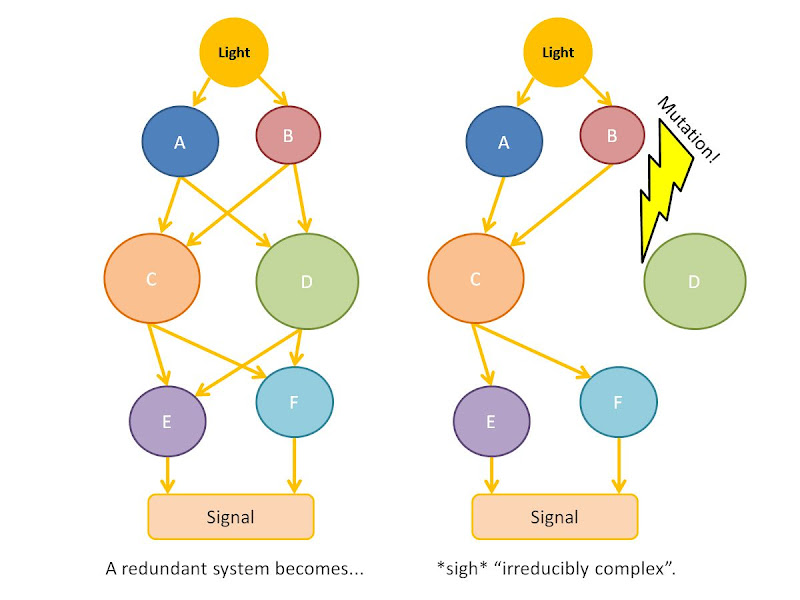
In the first instance, Behe is essentially claiming that irreducible complexity is a testable implication of the ID hypothesis, much as we can say that transitional fossils and genetic similarity (we share common DNA with all known life forms discovered to date) are testable implications of the evolution hypothesis. This is logically flawed in many respects. Firstly, in the design of various mechanisms, a human designer must consider a number of factors that will determine the amount of redundancy (or back-up systems, if you like) that a mechanism will have. The intended life time of the mechanism, the replacement cost of it and the practicality of repairing the object will all feed into that decision. A pocket watch can be repaired, as can a car. We’ll certainly build in some backup systems here and there, but where that isn’t practical, or essential, we’ll leave a number of critical systems in our design. Thus the pocket watch and the car become, “irreducibly complex”. By assuming that this feature is something we expect to see in designed life, we are making a rather significant assumption about the intention of the designer. We are assuming that the design considerations for an organism are in some manner similar to those for a mechanism such as a car or pocket watch. However, in a system that is difficult to repair (without modern medicine; a recent development), intended to last decades without maintenance and prone to replication errors (DNA mutation), do we really want to have critical systems with no backup? More to the point, if we assume that we do want such dangerous breaking points built into an organism, wouldn’t it make sense to build redundancy into the most important systems? Let’s consider some of the systems that Behe claims display this lack of redundancy in humans; the blood clotting cascade and the sight cascade. A biochemical cascade is a system in which a protein is affected by something (for example, light from our eye) and reacts by signalling another protein, which signals another and so forth until that signal is propagated to our brains. So we can see in the clotting cascade and the sight cascade that non-redundant points exist. Mutate specific proteins and the cascade breaks like the pocket watch. The sight and clotting cascades are extremely important systems for our survival and yet for some reason, redundancy exists in other, less (or equally) important biochemical systems. The chemokine system that controls the communication between our immune cells has multiple backup levels built into it, for example. We are thus forced to conclude that whether irreducible complexity is an expected feature of designed life depends heavily on the capabilities, level of intelligence, desires and intentions of the designer. If we assume that humans were directly designed, we are also forced to conclude that the designer is either technically limited, rather dim, malevolent or disinterested in individual human survival. Or a combinations of these traits. If we assume that our designer is actually fully “omnipotent”, we actually cannot make any assertion at all about what features we’d expect to see in designed life, since that designer could make life appear any way it chose without consequence.

The remaining two of Behe’s assertions can be refuted together. Whether we actually observe irreducible complexity in organisms and whether such systems could have arisen by a process of evolution go hand in hand. By definition, if we can imagine a means by which an irreducibly complex system could have arisen by evolution, then it is not in fact irreducibly complex. This is actually quite easy to show, and gives me a chance to crack the flow charts again! Let us imagine a simple “reducibly complex” protein cascade, in other words one which has redundancy. A “signal”, such as light, enters the system and can be picked up by protein A or B. These proteins can then interact with either of another two proteins C and D, which all may interact with more proteins further along the signal chain. Here then, is a fully redundant system which could easily have evolved by totally conventional means. We need to make only one change in order to create one of Behe’s “irreducibly complex” cascades. We delete A, B, C or D. So let’s take D out of the cascade. In nature, this could easily occur as a result of a mutation resulting in either a loss of function or a change of function. If we get the second case, a change in function (and one that is beneficial in its own respect) then successive mutations will make it difficult for us to connect the new protein to its historical role in the old cascade. Behe will see that cascade as being irreducibly complex, but that is an illusion created by evolution. The cascade is merely “complex”.


Such plausible evolutionary histories have now been demonstrated for most of Behe’s major examples of irreducible complexity, including both the sight cascade and the clotting cascade. Indeed, in the latter case, proteins that Behe claimed to be critical to certain cascades have been demonstrated to be absent in other species, with no ill effect. We can even see backup systems in these species which are related to systems in humans that have now been diverted towards alternate functions. Whilst the evolution of many cascades has not been fully explored, this does not for a moment suggest that irreducible complexity exists in organisms, since at the very least the simple method I’ve outlined allows the illusion of these to emerge by evolution. So, do we see irreducibly complex systems in organism? Nope, just the illusion of them.

Triplethink

So where does this leave ID creationism? In an awkward position really. Irreducible complexity, if we assume it to be real (and deliberate), represents a significant set of design flaws. These flaws are compounded by the Designer’s perplexing choice of a DNA-based inheritance system that is so very prone to replication errors. This then, gives us not an intelligent designer, but a being who is, frankly, a bit of a moron. I’m not saying I could do better, but nor am I claiming to be an intelligent designer. In some debates with creationists, I have seen this argument countered with the suggestion that the lack of redundancy in some systems is the result of the “degeneration” of the creator’s perfect design, due to the Fall of Man. By that logic, all life must have been created fully redundant, or at least with key systems featuring back-ups. These were then lost due to mutation, resulting in the very same systems that creationists now claim represent evidence of design. So this thinking would force creationists to abandon irreducible complexity as evidence of design. In reaction to that annoying point, others still contend that life was created “perfect”, in an entirely different way, in that it was entirely irreducibly complex throughout and that the redundancies which exist are some manner of reaction to the expulsion of life from that “perfect” first environment. By this of course they are referring once again to the expulsion of life from Eden. This though, demands that the creator must either have intervened to modify his creation (which is not supported by their literal interpretations of Genesis) or, and this is the part which really upsets creationists, we must have gained some functional back-ups by mutation; a process they need to claim is impossible in order to discredit evolution.

By bringing irreducible complexity to the table in the great creation versus evolution debate, the ID proponents actually force themselves into trap. If they will not accept evolution (or at least some other alternative to creationism) then they must accept one of three things; that the Designer is fallible, that irreducible complexity is not evidence of design, or that mutation can generate new functionality. Oops.


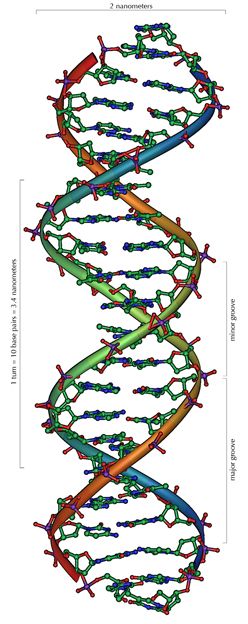
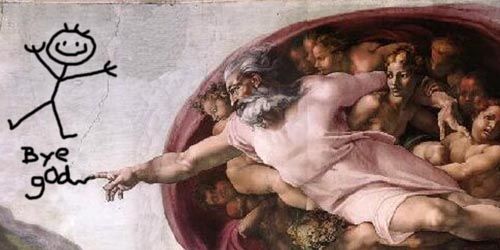
Image credits: DNA double helix by Michael Ströck. Released under the GFDL. Flow chart by the author. Creation of Adam by Michaelangelo. Public domain.

Thursday, 25 September 2008

Fear and Vaccination in London

Author's note: After my successful foray into soapboxing with the LHC story, I decided to get back up on the box again to trumpet my current hypothesis. Science, the scientific method and scepticism are misunderstood by almost everyone and something has to be done. For more evidence of just how bad things are, check out the ongoing research into the dangers of dihydrogen monoxide. The research itself is satire (sorry to spoil the fun, but I certainly don't want people to think I don't get it). The reactions of the public are the really frighetning part. Anyway, on to the self-righteous ranting.

In 1998 a British-based surgeon, Dr. Andrew Wakefield published a research paper in which he and his team tentatively identified a bowel disorder associated with autism which he coined “autistic enterocolitis” and speculated (a very important word there) that this might be caused by vaccination with the MMR vaccine. Most people are roughly aware of what MMR is. The measles, mumps and rubella triple vaccine. It is a mixture of the three viruses, alive but weakened to the point that they’re not even able to infect infants. They do however cause the recipient’s immune system to generate lots of cells and antibodies that will basically squash the three viruses should they ever be seen again. The need for vaccination against these three diseases is an easy case to make. Measles in adults can cause brain damage. Mumps may cause infertility in males, especially kids. Rubella, if it infects the unborn through the mother, can cause a wide range of birth defects. These complications don’t occur often- but the viruses are so infectious that those rare cases would be a big deal in any highly populated country.

Cause and Effect

So MMR was suggested to have an influence on autistic intestinal inflammation, but there was more. According to Wakefield’s paper, there also appeared to be a connection between the time of administration of MMR to a child and emergence of autism, though that element of the study was retrospective. The paper itself did not rock the boat in the mainstream media, th
ough the scientific community began criticising it immediately. The connection between MMR and autism was not clear, and the study group was small. Just twelve children, all selected because they had autism. At best, that sort of study would represent a starting point for some more solid research. To be meaningful and to make that connection really clear we’d need thousands of examples, and we’d to be able to compare our results with loads of non-autistic kids.

It wasn’t until Wakefield decided to jump outside of the peer-review system that things began to go bad. I discussed in a previous posting how science makes its way into the mainstream media. I even included a flow chart, which I’ll reproduce now. What Dr. Wakefield did was follow the path on the far right. Skipping all external controls and critique he instead decided to talk directly to the press. And what he had to say would cause a sensation. He called for a halt to administration of the MMR vaccine in favour of vaccinating for each of the three diseases separately over an extended time of several years. His stated reasoning was that he believed that MMR might be causing Autism. The initial response in the media was muted. The press release and an accompanying video released by Wakefield’s hospital drew some attention. Wakefield found himself defending his work in letters to the journal that had published his paper, Lancet. In 2000, Wakefield published more papers pushing his MMR hypothesis. Then in 2001, something snapped. Perhaps it was the publicity, the momentum built in the last couple of years. Perhaps Wakefield’s recent high-profile exit from his hospital position (a “mutual decision”) was noticed. Perhaps some of his new research papers pushed the right buttons. Whatever it was, the MMR and autism story hit the mainstream.

What Grows in Darkness

The newspapers went wild, particularly in the UK. By 2002, the stories in the press questioning the safety of MMR numbered in the thousands. Few dealt with the inconvenient peer-reviewed research papers that refuted Wakefield’s findings and the controversy dominated health reporting for several years. Here was a piece of news based on the (very carefully worded) concerns of a single surgeon. But somehow the line (in the Daily Mail at least) became “Scientists Fear MMR Link to Autism”. “One Scientist Cautiously and Inappropriately Suggests MMR Link to Autism” is not very catchy perhaps, but the fear mongering sentiment went further than headlines and permeated the reporting. As a direct result, MMR vaccination rates in the UK fell to 80% by 2003. In some urban areas of London, the rate was as low as 65%. When we learn a little about how vaccination works these, figures become even more alarming.

Vaccination is not 100% effective on a person-to-person basis, though it is usually above 99% effective. This is generally not an issue however, as vaccination also serves to protect the unvaccinated by eliminating the pool possible hosts for a given virus. Because your neighbours are all immune, your chances of even encountering the virus, let alone contracting it, are dramatically reduced. The virus is much less likely to be passed around by accident. This effect is called “herd immunity”. For the three viruses that MMR protects against, the threshold for good herd immunity is around 95% of the population. With the rate of uptake so low in 2005, the risk was rapidly increasing that herd immunity would collapse, resulting in large scale epidemics amongst the roughly 20% of unvaccinated children and the 1% for whom the vaccine had failed to take.

Predictably, the epidemics began around 2000, when the earliest signs of concern had begun to filter through to the public. Measles epidemics were reported in Ireland, Austria and Italy. Most significantly, measles incidences in the UK have increased steadily over the last eight years. Although the increase may appear minimal (from 56 cases per year in 1998 to an estimated 900 cases per year by 2006) the disease was declared “endemic” in the British population earlier this year. This means that the virus is now circulating freely in the population without need for re-infection from outside sources. So anyone without immunity is immediately at much greater risk. Herd immunity is degenerating. There is also evidence that travellers to and from Europe triggered minor outbreaks in the United States. Mumps is on the rise again also, primarily hitting age-groups who passed through infancy prior to the introduction of MMR. Some 70,000 cases were reported between 2004 and 2006. There were a handful of deaths as a result of the measles and mumps resurgences. Three deaths were reported in Ireland, one death in the UK and two cases of brain damage. Not many, but a reminder to us of times when these diseases were a true threat.

The degeneration of herd immunity is just the first step, there is another risk associated with allowing these viruses to become endemic. For every infected person there are literally billions of mumps, measles or rubella viruses in their system. The more viruses there are, the faster they reproduce. The faster they reproduce, the more often they mutate. With part of the population vaccinated and part not vaccinated, what we are doing is presenting the mutating viruses with an obstacle to overcome. The risk is growing that one of these three viruses may undergo the mutation required to evade MMR entirely.

In 2004, ten of Wakefield’s co-authors on the 1998 paper withdrew their support for the work. Since the first publication, at least twenty peer-reviewed research or review papers have discredited the MMR link to autism. Wakefield’s suggested new “autistic enterocolitis” has been dismissed by autism researchers as a common symptom of the condition. Ten years after the controversy began, MMR is not the only vaccine to fall victim to the resurgent paranoia and disillusionment with modern medicine, though this is a trend which predates the MMR scare. Some papers continue to lead a crusade against any proposals for new “multivalent” vaccines that, like MMR, would combine protection from several diseases.

Apportioning Blame

It was a need for a simple cause which ultimately brought the MMR crisis into being. But the fact is, there’s no known single cause for autism. And nor are the causes of the vaccination crisis as clear as they seem. It would be easy to point the finger at Dr. Wakefield. He’s certainly not free of blame. Wakefield’s 1998 study was prompted when he was approached by solicitors representing a group planning to sue MMR manufacturers for causing the autism. According to a Sunday Times report in 2006, Wakefield received money from that group to perform his 1998 study and it appears that some of the study participants were sourced by them too. It is also alleged that Wakefield’s hospital, who were quick to back his findings and arrange press contact, also received money in the form of legal aid. It seems clear from interviews at the time that Wakefield was aware of the fine balance of risks associated with his bold statement. He was aware that switching from the use of MMR to using three vaccines over a number of years very significantly increases a child’s risk of contracting one of the diseases in that time. Wakefield’s point was that the risk of autism outweighed both the fact that his results were unclear and the fact that his suggested course of action brought great risks. He should absolutely not have been going public with his poorly-conceived idea, yet his language in the press release and interviews was actually quite suitably cautious. The subtlety was lost on many news outlets. Rather than exhibit caution themselves, they perpetuated a fear-laden story that has done incalculable damage to public health in Europe. Many of these are the same papers that, years later, are now assassinating Wakefield’s character in light of professional misconduct charges. Ultimately we have to blame pretty much everybody; parents looking for simple answers, lawyers looking for litigation, a surgeon with a bias, a hospital looking for publicity, a media willing to spin anythi
ng to sell papers. Not to mention the confused reactions of most GPs and politicians (a blog in itself). And then there’s us. The scientists fought the good fight on the day, sure. But it could be argued that our aloofness from the public has created a culture in which science is only noticed when it is sensational; a culture in which the people have neither the education nor the inclination to view science with proper scepticism. It’s conceivable that just one of those groups had it in them to prevent this whole huge mess. Instead we are now facing continued vaccine paranoia and a dangerous resurgence of diseases we once had on the run.