Showing posts with label Genetic Drift. Show all posts

Thursday, 12 February 2009

Happy Darwin Day

Happy Darwin Day! Today we celebrate the 200th birthday of a scientific revolutionary. Like Pasteur, Mendel, Newton and Einstein, Darwin ushered in a shift in our perception of the evidence. In Darwin's lifetime the nature of life and its place in the world was explained by a mixture of assumption and religion. The science that existed was disparate. Biologists were just starting to understand heredity and variation. That variation displayed such great diversity at times, and yet such curious similarities. The distribution seemed to make little sense. Geologists were pointing to the massively stratified nature of their favourite medium (rock) as evidence that the world was far older than they had expected and wondered at the curious sequence of petrified organic structures they found within. Layer upon layer, that same progression across every strata and every geological discontinuity, across the world. The evidence was all there, merely waiting for someone to bring it together into one clear picture.

In November, we'll celebrate the 150th anniversary of the publication of that clear picture. Darwin's most prominent work, On the Origin of Species. Just as Newton's world was superceded, but not destroyed, by Einstein's; so too has Darwin's work found itself but a small part of a grander theory. His Laws of Natural Selection remain intact, his notions on heredity and genetics superceded by his contemporary Mendel. Both now standing along side the molecular genetics of Watson, Crick and Franklin.

There are those who say that scientists hold Darwin sacred. That his theory has become dogma. But it is likely that if Darwin read a modern biology textbook today, he would certainly disagree. He might even be a little annoyed at the absence of some of his hypotheses. But he would be delighted that natural selection has endured so well. And delighted that humanity has cast aside the notions of racial species divides which he loathed so much.

He gave us a part of the picture. We have accepted those ideas of his which have been borne out in experimentation, and discarded those which did not. Concepts that brought the evidence together in a revolutionary way. He was the first to understand our true nature and our place in the world. For that, we celebrate a great man and a scientist who stands as an example of dedication and remarkable insight.

Happy Birthday Charlie.

Tuesday, 21 October 2008

Moronic Design

November of next year brings to us biology-types, and to all of the scientifically-minded, a very special anniversary. It will mark the 150th year since the publication of what is certainly the most significant scientific work in the field of biology and one which would easily make the top three across the entirety of science. The publication in question is of course Charles Darwin’s “On the Origin of Species”. In it, Darwin laid out his case for his hypothesis on, as the title suggests, the origins of the variety (and similarity) we see between the many species of our planet.

The theory states the following. A common ancestor species once existed which produced offspring. As new generations of offspring were produced, inheritable differences (variations) began to appear in them. Some variations produced a benefit, others did not. Those variations that were beneficial enhanced the survival of the altered offspring and so those new traits were more likely to be passed on. The detrimental variations, whilst not always fatal, were less likely to be passed on simply because they reduced the carriers’ chances of survival and reproduction. Thus we have three simple mechanisms; reproduction, variation and selection. Add enough time, changing environments, migrations, separations and countless other influences and you get groups of organisms that have changed so much that they can no longer interbreed. These are broadly called species. So when you have these mechanisms working across an entire planet for over 3 billion years, you get a whole lot of species. I covered this whole process in a whimsical little story, posted a couple of months ago.

The scientific crisis and revolution that followed lasted decades, and was mostly heralded by Darwin’s supporters, rather than the man himself. His book and the works which confirmed his observations made a compelling case, and 150 years later his theory of evolution is accepted as the standing model of how life on Earth derived from a common ancestor. It is a theory that is so simple to explain that it is often described by scientists of all fields as “elegant” or even “beautiful”.

You may recall my explanation of how scientists develop a hypothesis, a testable idea, and then make observations and measurements that have the potential to disprove the hypothesis. If the hypothesis survives many observations, can be shown to predict bits we haven’t looked at yet, and can be confirmed independently, it becomes theory. A theory is the currently accepted model. That’s an important definition, because in common language “theory” generally has a meaning more like what scientists call a “hypothesis”. So when say, a creationist calls evolution “just a theory”, they are being rather misleading. Evolution (the process) is a fact and the model of that fact (the theory of evolution) is accepted by the vast majority of scientists as being entirely valid. So, more accurately, the theory of evolution is “just a (robust) theory (that has been re-tested and confirmed countless times over the course of 150 years and is now accepted as entirely valid by greater than 95% of scientists and greater than 99% of biologists”. Phew. I can see why they shorten it.

The metaphor-free zone

What I’m trying to get across is that evolution is a theory, in other words a model of reality, which is as well-accepted by scientists as Einstein’s theories of relativity. It’s important to remember that when considering the arguments of those who would tell you that evolution did not happen. I will generically refer to these movements as creationism, though that will certainly annoy them. Their common element is that they ascribe the creation of the Earth and of all life to a supernatural intelligence. In most variants this is the Christian God, and the basis of their “theory” is a fully literal interpretation of the book of Genesis. No, symbolism, no metaphor. A literal six day creation of the universe and all life in it.

There’s insufficient space here (and I have insufficient time) to fully explore the evolution versus creationism debate, but I would invite readers to visit TalkOrigins or explore various internet debates on the matter to get a feel for how in-depth the row has become over the past few decades. Leave your sanity at the door, it will only hinder you. Rather than delve into that whole mess, I will instead focus on the core issue that is used by one branch of creationists; the “intelligent design” (ID) proponents. ID proponents believe that life was designed by a great intelligence. They are unspecific as to the age of the Earth (traditional creationists put the limit at around 10,000 years) but believe that life was created in a single creation event and has varied only within tight boundaries since then. They also contend, as do most creationists, that mutation (the process that causes the variation in evolution) cannot create new function, but rather can only break the function of a gene or restore its previous function. Officially, they do not identify the intelligent designer as “God”, but internal documents leaked from the ID inner circle reveal that they are in fact Christian creationists with a secular gloss over them. This is apparently to make their ideas appear more palatable to institutions such as the secular US education system into which they would like to insert their “science”. So we can quite confidently label intelligent design as creationism.

If ID constitutes science then it must have a testable hypothesis at its core. Evolution states as its core hypothesis that all life derived from a common ancestor by variation and selection. That statement has many implications which we may test. We should, for example, be able to find evidence of organisms, perhaps extinct, which show a transition between known species. Evolution thus makes a prediction that we ought to be able to find such species in the fossil record. And we do. What does ID predict? Not much. If life is entirely designed by a creator with only one specified trait (intelligence), it could look like almost anything at any level. It could even be made to look entirely as though it evolved. It’s thus rather unsurprising that creationists in generally spend most of their time trying to discredit evolution rather than testing things such as ID. They propose a false dichotomy (a made-up two way choice); if evolution is false, creationism must be true. All other imaginable or unimaginable options are somehow off the table.

Scientism

In their flailing attempt to make ID into a science, its proponents latched onto the work of ID defender Michael Behe who suggested in his 1996 book Darwin’s Black Box that intelligent design was proven plausible by the existence of what he termed “irreducible complexity” in biological systems. Irreducible complexity, according to Behe, is a property of any system which performs a function but which is disabled entirely if we remove any critical part of that system. Thus, a clockwork pocket watch would be considered irreducibly complex, as removing a cog will cause the watch to stop functioning as intended. Behe firstly contends that this is a property we expect to see in any intelligently designed system and secondly that the property is observable in life forms. He also claims that such systems cannot arise by evolution, since the various parts would have to evolve at the very same time and this is improbable. I will now attack all three assertions.

In the first instance, Behe is essentially claiming that irreducible complexity is a testable implication of the ID hypothesis, much as we can say that transitional fossils and genetic similarity (we share common DNA with all known life forms discovered to date) are testable implications of the evolution hypothesis. This is logically flawed in many respects. Firstly, in the design of various mechanisms, a human designer must consider a number of factors that will determine the amount of redundancy (or back-up systems, if you like) that a mechanism will have. The intended life time of the mechanism, the replacement cost of it and the practicality of repairing the object will all feed into that decision. A pocket watch can be repaired, as can a car. We’ll certainly build in some backup systems here and there, but where that isn’t practical, or essential, we’ll leave a number of critical systems in our design. Thus the pocket watch and the car become, “irreducibly complex”. By assuming that this feature is something we expect to see in designed life, we are making a rather significant assumption about the intention of the designer. We are assuming that the design considerations for an organism are in some manner similar to those for a mechanism such as a car or pocket watch. However, in a system that is difficult to repair (without modern medicine; a recent development), intended to last decades without maintenance and prone to replication errors (DNA mutation), do we really want to have critical systems with no backup? More to the point, if we assume that we do want such dangerous breaking points built into an organism, wouldn’t it make sense to build redundancy into the most important systems? Let’s consider some of the systems that Behe claims display this lack of redundancy in humans; the blood clotting cascade and the sight cascade. A biochemical cascade is a system in which a protein is affected by something (for example, light from our eye) and reacts by signalling another protein, which signals another and so forth until that signal is propagated to our brains. So we can see in the clotting cascade and the sight cascade that non-redundant points exist. Mutate specific proteins and the cascade breaks like the pocket watch. The sight and clotting cascades are extremely important systems for our survival and yet for some reason, redundancy exists in other, less (or equally) important biochemical systems. The chemokine system that controls the communication between our immune cells has multiple backup levels built into it, for example. We are thus forced to conclude that whether irreducible complexity is an expected feature of designed life depends heavily on the capabilities, level of intelligence, desires and intentions of the designer. If we assume that humans were directly designed, we are also forced to conclude that the designer is either technically limited, rather dim, malevolent or disinterested in individual human survival. Or a combinations of these traits. If we assume that our designer is actually fully “omnipotent”, we actually cannot make any assertion at all about what features we’d expect to see in designed life, since that designer could make life appear any way it chose without consequence.

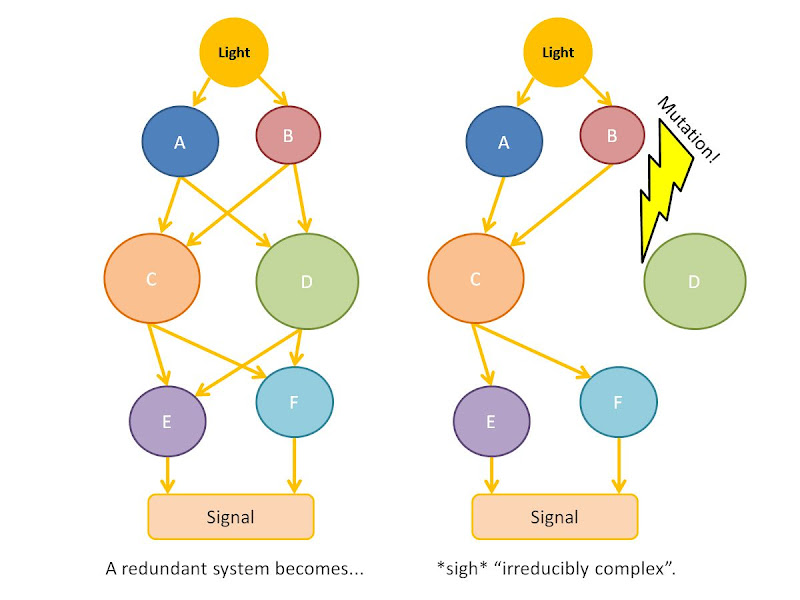
The remaining two of Behe’s assertions can be refuted together. Whether we actually observe irreducible complexity in organisms and whether such systems could have arisen by a process of evolution go hand in hand. By definition, if we can imagine a means by which an irreducibly complex system could have arisen by evolution, then it is not in fact irreducibly complex. This is actually quite easy to show, and gives me a chance to crack the flow charts again! Let us imagine a simple “reducibly complex” protein cascade, in other words one which has redundancy. A “signal”, such as light, enters the system and can be picked up by protein A or B. These proteins can then interact with either of another two proteins C and D, which all may interact with more proteins further along the signal chain. Here then, is a fully redundant system which could easily have evolved by totally conventional means. We need to make only one change in order to create one of Behe’s “irreducibly complex” cascades. We delete A, B, C or D. So let’s take D out of the cascade. In nature, this could easily occur as a result of a mutation resulting in either a loss of function or a change of function. If we get the second case, a change in function (and one that is beneficial in its own respect) then successive mutations will make it difficult for us to connect the new protein to its historical role in the old cascade. Behe will see that cascade as being irreducibly complex, but that is an illusion created by evolution. The cascade is merely “complex”.


Such plausible evolutionary histories have now been demonstrated for most of Behe’s major examples of irreducible complexity, including both the sight cascade and the clotting cascade. Indeed, in the latter case, proteins that Behe claimed to be critical to certain cascades have been demonstrated to be absent in other species, with no ill effect. We can even see backup systems in these species which are related to systems in humans that have now been diverted towards alternate functions. Whilst the evolution of many cascades has not been fully explored, this does not for a moment suggest that irreducible complexity exists in organisms, since at the very least the simple method I’ve outlined allows the illusion of these to emerge by evolution. So, do we see irreducibly complex systems in organism? Nope, just the illusion of them.

Triplethink

So where does this leave ID creationism? In an awkward position really. Irreducible complexity, if we assume it to be real (and deliberate), represents a significant set of design flaws. These flaws are compounded by the Designer’s perplexing choice of a DNA-based inheritance system that is so very prone to replication errors. This then, gives us not an intelligent designer, but a being who is, frankly, a bit of a moron. I’m not saying I could do better, but nor am I claiming to be an intelligent designer. In some debates with creationists, I have seen this argument countered with the suggestion that the lack of redundancy in some systems is the result of the “degeneration” of the creator’s perfect design, due to the Fall of Man. By that logic, all life must have been created fully redundant, or at least with key systems featuring back-ups. These were then lost due to mutation, resulting in the very same systems that creationists now claim represent evidence of design. So this thinking would force creationists to abandon irreducible complexity as evidence of design. In reaction to that annoying point, others still contend that life was created “perfect”, in an entirely different way, in that it was entirely irreducibly complex throughout and that the redundancies which exist are some manner of reaction to the expulsion of life from that “perfect” first environment. By this of course they are referring once again to the expulsion of life from Eden. This though, demands that the creator must either have intervened to modify his creation (which is not supported by their literal interpretations of Genesis) or, and this is the part which really upsets creationists, we must have gained some functional back-ups by mutation; a process they need to claim is impossible in order to discredit evolution.

By bringing irreducible complexity to the table in the great creation versus evolution debate, the ID proponents actually force themselves into trap. If they will not accept evolution (or at least some other alternative to creationism) then they must accept one of three things; that the Designer is fallible, that irreducible complexity is not evidence of design, or that mutation can generate new functionality. Oops.


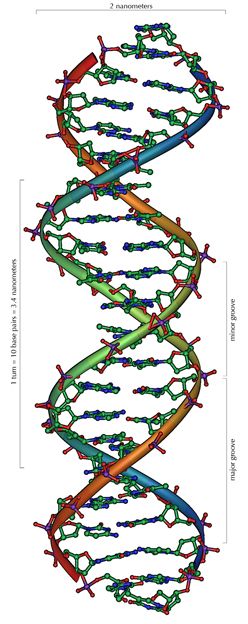
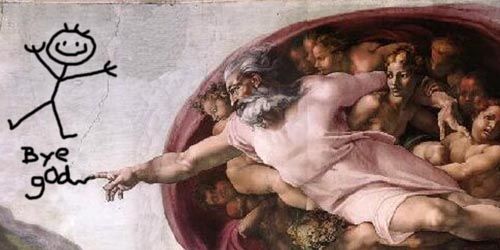
Image credits: DNA double helix by Michael Ströck. Released under the GFDL. Flow chart by the author. Creation of Adam by Michaelangelo. Public domain.

Monday, 28 July 2008

The Great Wormtown Spade Disaster (Part 2)

Wormtown is about to face a natural disaster of sorts, although of course the reader will know better than the worms do! A huge shovel crashes through Wormtown, scoops a huge chunk out of it, and throws the chunk into a neighbouring field. Quite a sight, if one had eyes. The surprised Worms within this temporarily-airborne piece of home are fairly resilient creatures and survive the unceremonious landing with only a few fatalities. They quickly abandon the collapsed ruins of their part of Wormtown (it has now become aerated and quite uncomfortably cold) and burrow into the new field to found the community of Farland. Back in the old field, the survivors of the Great Wormtown Spade Disaster proceed to put their lives, such as they are, back together.
The day that Farland is founded, the populations of Farland and Wormtown are quite similar in size and composition. Although the Sharpies have a harder time escaping underground during the foundation of Farland, none-the-less roughly one in ten worms is still a Sharpie. This state of affairs won’t last for long though, because things in Farland are different. The Worms aren’t in Kansas anymore (or Wormtown for that matter).
Farland is a hostile land. Foods are in short supply, and a strange local kind of Foods called Fast Foods are more common but are often too quick to catch. Fast foods make life a lot tougher for the Farland Sharpies. Also, Eaters are more numerous here, and more aggressive, something which makes life very very difficult for the Farland Smoothies, who quickly find themselves being gobbled up by the hundreds. Within a few years it becomes clear that one of these two great pressures of life outweighs the other. The Smoothies of Farland are extinct because of the Eaters. The Sharpies struggle on, though their numbers are limited from generation to generation. It’s not the Eaters that are making life difficult for the Sharpies though, as the Eaters find the Farland Sharpies rather unpleasant to consume due to their pointy texture. No, what troubles the Sharpies is the shortage of Foods. Just as it seems the new community will never reach the heights of the long-forgotten and now mythical Wormtown, a child is born to an unassuming Sharpie.
The child is called Flash, because the muscles around his sharp graspers are larger and stronger than most Sharpies, allowing him to get over the Sharpie movement impediment and move quickly. Flash does very well in Farland. He finds that his speed allows him to eat the elusive Fast Foods. He still has his Sharpie features too and so Eaters avoid him. Flash easily finds several mates and has plenty of kids. Just like his distant ancestor Sharpie, Flash’s kids are a mixture of normal Sharpies and a smaller number of little Flashes. As the years pass, the Sharpies and Flashes mate with each other, but with each generation, the numbers of purebred Sharpies becomes less and less as the Flashes as Foods tend to get snapped up by the quicker Worms. The purebred Sharpies, who once struggled but survived in Farland, become extinct just as the Farland Smoothies before them.
The Flashes of Farland thrive. Their kingdom spreads widely. Just like Sharpie and Flash before them, special kids are sometimes born. Not all of them do so well. Some die before they can have kids. Others have kids who find themselves beaten in the race for food or gobbled by Eaters. But some survive to bring great changes to the Farlanders.
The Farlander civilisation spreads so far that they one day encounter a strange new kind of animal in a distant land. Not small like Foods or big like Eaters, they have found the Fast Smoothies. The Fast Smoothies are descendants of the Smoothies who stayed behind in Wormtown. In the great many years since the Shovel came they spread out into the lands between Wormtown and Farland. Just like the Flashes, they became faster to catch the local Fast Foods they encountered and now they have found their long lost brethren. The Fast Smoothies have long since out bred the old Wormtown Sharpies and Smoothies because they could eat even more of the Foods of Wormtown. So much has changed that the Farlanders and Wormtowners wouldn’t recognise each other any longer. The bulky, spiky Flashes of Farland only vaguely resemble the lithe Fast Smoothies of Wormtown. And the more adventurous of them find that interbreeding produces no young.
And so the lands between Farland and Wormtown (which the locals would call Fencepost, if they were able) come to support a mixture of both communities, a balance which prevails for many years. But the Flashes and the Fast Smoothies never successfully interbreed. They have become different species, all thanks to strange Worms like Sharpie and Flash, and an even stranger phenomenon called The Shovel.

To learn more: Google these terms: Introduction to Evolution, Speciation, Mutation, Genetic Drift, Natural Selection, Habitat Fragmentation, Peripatric Speciation.

The Great Wormtown Spade Disaster (Part 1)

Author's note: The story below is my attempt to put some of the core concepts of Evolution into terms that are accessible to a wide audience. I'd hope it could be read and understood by anyone from the age of 10 without patronising anyone over the age of 12... a tall order maybe. For anyone interested in what it all means, I've listed some of the concepts touched on in their scientific terms at the end.

Wormtown isn’t much to look at. Given that its inhabitants lack eyes, perhaps that does not matter. It consists of little more than some earth in a field Somewhere. It is inhabited of course by some Worms, who would have given Wormtown its name, if they had a language or indeed any means to speak it. The soil is warm, rarely disturbed and the general conditions are mild. The worms themselves are a simple bunch. They are microscopic and quite smooth. They have just three small grasping stubs on each side of their long bodies to aid their movement through the soil. And of course they also have the bits needed for eating and reproducing. Although the reader might have difficulty telling the difference, there are both male and female worms. The females lay eggs in large communal nurseries and their chosen male partners fertilise them. The process is a little messy though, and sometimes the wrong eggs get fertilized by accident (or on purpose if a male worm in question is a bit of a creep). Other inhabitants of the area include smaller animals called Foods and bigger ones called Eaters. The Worms, called Smoothies because of their appearance, eat the Foods when they can catch them and sometimes fall prey themselves to the Eaters. Aside from eating and mating, the Smoothies do little more than move around through the soil. Sometimes the Smoothies burrow to the surface and feel the Sun, which is rather painful and makes them burrow back down again. This state of affairs persists for a Very Long Time.
Every now and again a Special Child is born. Sometimes they have brightly a short body or coloured skin (the Smoothies can’t see this but the Foods and Eaters sure can). Sometimes they have no graspers or a stomach that won’t work. Special Children almost always die early. The ones that do survive pass on their dangerous characteristics to some of their children who themselves, sadly, die early.
One day, a worm is born with strange graspers. Instead of short and blunt graspers made toughened skin, this strange child has longer, sharper graspers. Of course, Worms have previously been born with bigger or smaller graspers than usual, but these differences never seem to help much. This sharpness is new and strange and the child is named Sharpie. Being simple souls (and also blind), the worms don’t hold this peculiar look against Sharpie, not that they could do much about her if they did. Still though, Sharpie finds her life a bit more awkward than the other worms. Her pointy horns make movement more difficult, which makes Foods harder to catch. Luckily, Foods are quite plentiful in Wormtown and so Sharpie survives, albeit struggling somewhat, and even lives to find a free-thinking mate and have children of her own.
Most of Sharpie’s kids are quite normal-looking Smoothies. But a few, males and females alike, have the same strange horns as their mother. Sharpie herself dies rather young as a result of her impaired movement, but having had a number of children, the reader can feel satisfied that Sharpie has made her mark on the world. So it is that a generation of Sharpies goes out into Wormtown. And they fair reasonably well. Sharpies still struggle to catch Foods when compared to Smoothies, just has their mother did, but their sharp horns give them a new edge that only now becomes clear; Eaters are less afraid to eat them! Sharpies and Smoothies mate frequently, producing litters that are a mixture of Sharpies and Smoothies. As the generations pass, this means that Sharpies are born that are distantly related enough to mate with each other without making the reader feel vaguely uncomfortable.
The years pass and the population of Wormtown settles into an equilibrium, a balance of sorts. So long as there are plenty of Foods, both the Smoothies and Sharpies can survive, though at different success rates. As long as there are predators attacking both, the Sharpies can partially overcome their disadvantage when it comes to getting Foods. And so at any one time, about one in ten citizens of Wormtown is a Sharpie. They form a sort of racial minority who thankfully don’t suffer from much by way of discrimination, if only because the Worms are rather lacking in the brains required for one to be properly ignorant.
The idyllic, peaceful and now quite diverse community of Wormtown is about to face disaster.

Part 2: In Which Disaster Happens

To learn more: Google these terms: Introduction to Evolution, Speciation, Mutation, Genetic Drift, Natural Selection, Habitat Fragmentation, Peripatric Speciation.