Showing posts with label DNA. Show all posts

Thursday, 12 February 2009

Happy Darwin Day

Happy Darwin Day! Today we celebrate the 200th birthday of a scientific revolutionary. Like Pasteur, Mendel, Newton and Einstein, Darwin ushered in a shift in our perception of the evidence. In Darwin's lifetime the nature of life and its place in the world was explained by a mixture of assumption and religion. The science that existed was disparate. Biologists were just starting to understand heredity and variation. That variation displayed such great diversity at times, and yet such curious similarities. The distribution seemed to make little sense. Geologists were pointing to the massively stratified nature of their favourite medium (rock) as evidence that the world was far older than they had expected and wondered at the curious sequence of petrified organic structures they found within. Layer upon layer, that same progression across every strata and every geological discontinuity, across the world. The evidence was all there, merely waiting for someone to bring it together into one clear picture.

In November, we'll celebrate the 150th anniversary of the publication of that clear picture. Darwin's most prominent work, On the Origin of Species. Just as Newton's world was superceded, but not destroyed, by Einstein's; so too has Darwin's work found itself but a small part of a grander theory. His Laws of Natural Selection remain intact, his notions on heredity and genetics superceded by his contemporary Mendel. Both now standing along side the molecular genetics of Watson, Crick and Franklin.

There are those who say that scientists hold Darwin sacred. That his theory has become dogma. But it is likely that if Darwin read a modern biology textbook today, he would certainly disagree. He might even be a little annoyed at the absence of some of his hypotheses. But he would be delighted that natural selection has endured so well. And delighted that humanity has cast aside the notions of racial species divides which he loathed so much.

He gave us a part of the picture. We have accepted those ideas of his which have been borne out in experimentation, and discarded those which did not. Concepts that brought the evidence together in a revolutionary way. He was the first to understand our true nature and our place in the world. For that, we celebrate a great man and a scientist who stands as an example of dedication and remarkable insight.

Happy Birthday Charlie.

Tuesday, 30 December 2008

Why You’re Awesome: Part 1

I thought I'd finish 2008 with the first in what I intend to be a semi-regular series on some of the random cool stuff that's going on with your biology and how evolution got you there.

The first time single-celled organisms decided to switch to communism (i.e. stick together to become multi-cellular organisms like cabbages, hamsters and us), they immediately faced a compromise. Sure, sticking together meant more food and more safety, but reproduction was now a more complicated matter. And as life became more complex, reproduction just got slower and slower. And because the rate that we can evolve is strongly influenced by our reproduction rate, this means that the bacteria and other little blighters that like to infect us have a massive evolutionary edge. We measure the time it takes for organisms to reproduce in terms of generation times, the average time it takes between a new organism being born and it getting around to reproducing for itself. After millions of years of evolution, the differences between the generation times of single-celled organisms such as bacteria and us humans is massive. The average human takes some 25-30 years to reproduce. Bacteria can divide and then divide again in 20 minutes. And so, bacteria and viruses evolve at a simply astounding rate by comparison to us big old lumbering animal types. Although we’ve had immune systems since those earliest days of multi-cellular life, the mutation rate problem was still there. Our immune cells work by recognising patterns- bits of bacteria, the surfaces of viruses, maybe some of the proteins from a parasite. But what good is it having cells that see what’s on the outside of a bacterium when a bacterium can change its outfit a million times before your cells can get their pants on in the morning? Our immune cells had to work in terms of broad patterns, and if one of those patterns changed due to mutation, things invariably got ugly.

Of course, if that had been the end of the story, we wouldn’t be here to talk about it. There’d just be a load of bacteria hanging around wondering where all the easy food went. Evolution, in its elegant non-wisdom, provided a solution. The key was to fight fire with fire. We vertebrates evolved a special group of cells that, when first made by our bodies (and we make loads of them every day), undergo their own randomised mutations. These special mutations occur only within a set part of our genetic code- right in the part which recognises those nasty bugs and parasites. Just by allowing chaotic re-arrangements of that little part of our DNA in a select set of cells, we we’re suddenly back in the game. With enough of these cells, we can now recognise some 10e12 patterns (that’s one thousand billion). In effect, we harnessed the driving force of evolution itself. Tightly controlled chaos. And it worked. Every animal with a spine has those precious cells. The lymphocytes, also called T cells and B cells. They’re awesome really.

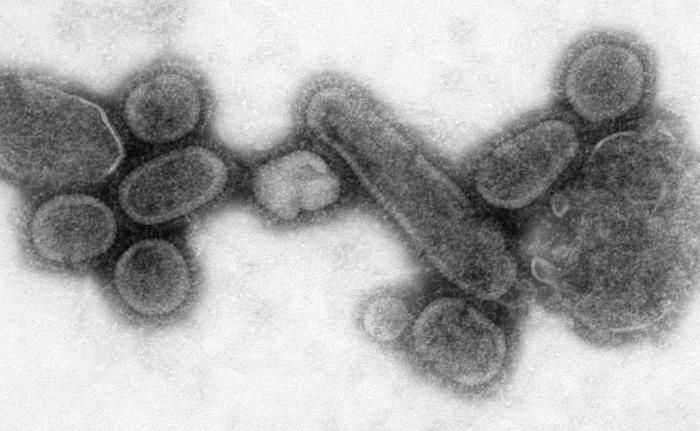
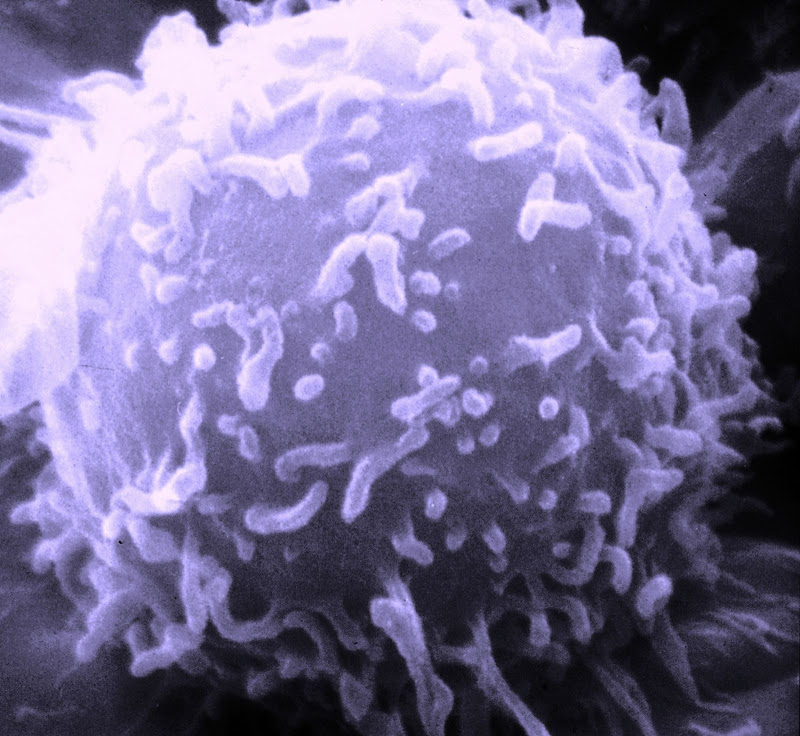
Flu virus image from the Centers for Disease Control and Prevention's Public Health Image Library (Public Domain). Lymphocyte image from the National Cancer Institute (Public Domain).

Wednesday, 29 October 2008

Requiem for a Culture

When the world’s first clone, Dolly the sheep, took her first tentative steps, some more lateral thinking conservationists might be forgiven for having imagined that this new technological triumph could well herald the end of extinction. For what better way could there be to immortalise a species under threat than to sequence its gene in their entirety and simply clone new individuals on demand. So long as tissue or blood samples could be taken from an ailing species, they could even be frozen and preserved long after the extinction of a species, simply waiting for the technology to catch up. Of course some manner of artificial womb or surrogacy system would be needed in order to create a viable and reproducing population of adequate size, but to imagine that such technical hurdles could be overcome would not at all be unreasonable. The problem of premature ageing that faced poor Dolly is also unlikely to be an insurmountable obstacle. Despite all of this, I suspect there is in fact something that will stand in our way, something much more difficult to replicate than mere DNA.

Our understanding of evolution has perhaps led us to think in too narrow terms about what it is that makes a species. It is certainly conceivable that the technology that created Dolly could well become streamlined and commonplace enough to be applied to almost any species, but is that in fact enough to return a species from extinction? Consider the case of the curiously named Poʻouli, a bird native only to Hawai’i. Tragically, for those who consider biodiversity to be of benefit to the world, the last known individual of the species died whilst biologists attempted to locate a possible female still in the wild. Tissue samples were taken from the male before its death in the hopes that developments in cloning technology might one day revive the species. Of course, without samples from a female, it is debatable as to what good cloning males will do. But this is not the greatest impediment to resurrecting the Poʻouli. After all, we know biochemically and genetically what sets male and female apart. At a push, we might be able to engineer a female based on the male genome. But when we finally manage to create the new generation of Poʻouli hatchlings, who will they look to for guidance?

That might sounds like a pretty odd question to ask about birds. But of course, imprinting upon a parent animal is extremely important for hatchlings to develop normal behavior; in many repects they learn how to be birds from their parents, who learned from their parents. Whilst we’ve managed to emulate imprinting for some endangered species of wild geese by doing clever things such as having them fly alongside people in hang-gliders, it is questionable just how well we can emulate the imprinting behavior and training of a species we can no longer study. Imprinting in birds is just one example of the countless forms of learning that are seen throughout animal species. Although it would probably not be a popular application of the term I view this non-genetic inheritance as the simplest form of culture. And in my view, even simple culture is no trivial component of any species. Of course we tend to think of culture as a strictly human phenomenon and certainly our species demonstrates just how complex culture can become. From the simple act of imparting knowledge between countless generations, we have gained everything from agriculture to religion and of course science. I am quite sure that many of the primatologists studying our closest animal relatives would not hesitate to extend the concept of culture beyond humans.

So although we have genetics in the bag, it is culture that potentially becomes irrecoverable whenever a species becomes extinct. The day an extinct species is reborn, how do we know they’re behaving as they used to? Will the Poʻouli species actually be restored if we clone a thousand chicks, raise them by hand and release them? To this day we are discovering new facets of the cultural inheritances of many species, even in those species that ought by now to be well-known to us, such as chimpanzees. Of course, for “simple” species such as birds and the smaller mammal species, it may be that we could restore a viable culture by simply cloning large numbers of individuals and allowing random behavior, time and pure natural selection to do their work. After all, cultural elements, like genes, are subject to a form of evolution. Those that confer advantage will be inherited at a higher rate than those that do not. This is something like Dawkins’ meme hypothesis, albeit extended to all life forms capable of learning. But how will we know if the emergent culture really resembles the original? The problem really is our lack of knowledge of the “memetics” of the species. While we may sequence a genome, even store it as pure computer data for later replication, how do we so accurately measure the culture of a species?

Behavioral biology is of course the field that provides our answers, but there’s no escaping the realization that what we are struggling with is something far less tangible than genes, and far more open to human ignorance or misinterpretation. In the 35 years that biologists had to observe the Poʻouli, can we be sure that every aspect of their simple culture was studied? Can we be sure that every nuance of their social interactions was even noticed? This is the intimidating challenge that really faces conservationists. With so many species now endangered, the task at hand is staggering. We may have to accept that no matter how much DNA we sample and sequence, species such as the Poʻouli, the Dodo, the Golden Toad and the Tarpan are lost to us in a manner we probably couldn’t have measured when they still lived.


Po'ouli image courtesy of the United States Federal Government under the terms of Title 17, Chapter 1, Section 105 of the US Code. Obtained from Wikipedia.

Tuesday, 21 October 2008

Moronic Design

November of next year brings to us biology-types, and to all of the scientifically-minded, a very special anniversary. It will mark the 150th year since the publication of what is certainly the most significant scientific work in the field of biology and one which would easily make the top three across the entirety of science. The publication in question is of course Charles Darwin’s “On the Origin of Species”. In it, Darwin laid out his case for his hypothesis on, as the title suggests, the origins of the variety (and similarity) we see between the many species of our planet.

The theory states the following. A common ancestor species once existed which produced offspring. As new generations of offspring were produced, inheritable differences (variations) began to appear in them. Some variations produced a benefit, others did not. Those variations that were beneficial enhanced the survival of the altered offspring and so those new traits were more likely to be passed on. The detrimental variations, whilst not always fatal, were less likely to be passed on simply because they reduced the carriers’ chances of survival and reproduction. Thus we have three simple mechanisms; reproduction, variation and selection. Add enough time, changing environments, migrations, separations and countless other influences and you get groups of organisms that have changed so much that they can no longer interbreed. These are broadly called species. So when you have these mechanisms working across an entire planet for over 3 billion years, you get a whole lot of species. I covered this whole process in a whimsical little story, posted a couple of months ago.

The scientific crisis and revolution that followed lasted decades, and was mostly heralded by Darwin’s supporters, rather than the man himself. His book and the works which confirmed his observations made a compelling case, and 150 years later his theory of evolution is accepted as the standing model of how life on Earth derived from a common ancestor. It is a theory that is so simple to explain that it is often described by scientists of all fields as “elegant” or even “beautiful”.

You may recall my explanation of how scientists develop a hypothesis, a testable idea, and then make observations and measurements that have the potential to disprove the hypothesis. If the hypothesis survives many observations, can be shown to predict bits we haven’t looked at yet, and can be confirmed independently, it becomes theory. A theory is the currently accepted model. That’s an important definition, because in common language “theory” generally has a meaning more like what scientists call a “hypothesis”. So when say, a creationist calls evolution “just a theory”, they are being rather misleading. Evolution (the process) is a fact and the model of that fact (the theory of evolution) is accepted by the vast majority of scientists as being entirely valid. So, more accurately, the theory of evolution is “just a (robust) theory (that has been re-tested and confirmed countless times over the course of 150 years and is now accepted as entirely valid by greater than 95% of scientists and greater than 99% of biologists”. Phew. I can see why they shorten it.

The metaphor-free zone

What I’m trying to get across is that evolution is a theory, in other words a model of reality, which is as well-accepted by scientists as Einstein’s theories of relativity. It’s important to remember that when considering the arguments of those who would tell you that evolution did not happen. I will generically refer to these movements as creationism, though that will certainly annoy them. Their common element is that they ascribe the creation of the Earth and of all life to a supernatural intelligence. In most variants this is the Christian God, and the basis of their “theory” is a fully literal interpretation of the book of Genesis. No, symbolism, no metaphor. A literal six day creation of the universe and all life in it.

There’s insufficient space here (and I have insufficient time) to fully explore the evolution versus creationism debate, but I would invite readers to visit TalkOrigins or explore various internet debates on the matter to get a feel for how in-depth the row has become over the past few decades. Leave your sanity at the door, it will only hinder you. Rather than delve into that whole mess, I will instead focus on the core issue that is used by one branch of creationists; the “intelligent design” (ID) proponents. ID proponents believe that life was designed by a great intelligence. They are unspecific as to the age of the Earth (traditional creationists put the limit at around 10,000 years) but believe that life was created in a single creation event and has varied only within tight boundaries since then. They also contend, as do most creationists, that mutation (the process that causes the variation in evolution) cannot create new function, but rather can only break the function of a gene or restore its previous function. Officially, they do not identify the intelligent designer as “God”, but internal documents leaked from the ID inner circle reveal that they are in fact Christian creationists with a secular gloss over them. This is apparently to make their ideas appear more palatable to institutions such as the secular US education system into which they would like to insert their “science”. So we can quite confidently label intelligent design as creationism.

If ID constitutes science then it must have a testable hypothesis at its core. Evolution states as its core hypothesis that all life derived from a common ancestor by variation and selection. That statement has many implications which we may test. We should, for example, be able to find evidence of organisms, perhaps extinct, which show a transition between known species. Evolution thus makes a prediction that we ought to be able to find such species in the fossil record. And we do. What does ID predict? Not much. If life is entirely designed by a creator with only one specified trait (intelligence), it could look like almost anything at any level. It could even be made to look entirely as though it evolved. It’s thus rather unsurprising that creationists in generally spend most of their time trying to discredit evolution rather than testing things such as ID. They propose a false dichotomy (a made-up two way choice); if evolution is false, creationism must be true. All other imaginable or unimaginable options are somehow off the table.

Scientism

In their flailing attempt to make ID into a science, its proponents latched onto the work of ID defender Michael Behe who suggested in his 1996 book Darwin’s Black Box that intelligent design was proven plausible by the existence of what he termed “irreducible complexity” in biological systems. Irreducible complexity, according to Behe, is a property of any system which performs a function but which is disabled entirely if we remove any critical part of that system. Thus, a clockwork pocket watch would be considered irreducibly complex, as removing a cog will cause the watch to stop functioning as intended. Behe firstly contends that this is a property we expect to see in any intelligently designed system and secondly that the property is observable in life forms. He also claims that such systems cannot arise by evolution, since the various parts would have to evolve at the very same time and this is improbable. I will now attack all three assertions.

In the first instance, Behe is essentially claiming that irreducible complexity is a testable implication of the ID hypothesis, much as we can say that transitional fossils and genetic similarity (we share common DNA with all known life forms discovered to date) are testable implications of the evolution hypothesis. This is logically flawed in many respects. Firstly, in the design of various mechanisms, a human designer must consider a number of factors that will determine the amount of redundancy (or back-up systems, if you like) that a mechanism will have. The intended life time of the mechanism, the replacement cost of it and the practicality of repairing the object will all feed into that decision. A pocket watch can be repaired, as can a car. We’ll certainly build in some backup systems here and there, but where that isn’t practical, or essential, we’ll leave a number of critical systems in our design. Thus the pocket watch and the car become, “irreducibly complex”. By assuming that this feature is something we expect to see in designed life, we are making a rather significant assumption about the intention of the designer. We are assuming that the design considerations for an organism are in some manner similar to those for a mechanism such as a car or pocket watch. However, in a system that is difficult to repair (without modern medicine; a recent development), intended to last decades without maintenance and prone to replication errors (DNA mutation), do we really want to have critical systems with no backup? More to the point, if we assume that we do want such dangerous breaking points built into an organism, wouldn’t it make sense to build redundancy into the most important systems? Let’s consider some of the systems that Behe claims display this lack of redundancy in humans; the blood clotting cascade and the sight cascade. A biochemical cascade is a system in which a protein is affected by something (for example, light from our eye) and reacts by signalling another protein, which signals another and so forth until that signal is propagated to our brains. So we can see in the clotting cascade and the sight cascade that non-redundant points exist. Mutate specific proteins and the cascade breaks like the pocket watch. The sight and clotting cascades are extremely important systems for our survival and yet for some reason, redundancy exists in other, less (or equally) important biochemical systems. The chemokine system that controls the communication between our immune cells has multiple backup levels built into it, for example. We are thus forced to conclude that whether irreducible complexity is an expected feature of designed life depends heavily on the capabilities, level of intelligence, desires and intentions of the designer. If we assume that humans were directly designed, we are also forced to conclude that the designer is either technically limited, rather dim, malevolent or disinterested in individual human survival. Or a combinations of these traits. If we assume that our designer is actually fully “omnipotent”, we actually cannot make any assertion at all about what features we’d expect to see in designed life, since that designer could make life appear any way it chose without consequence.

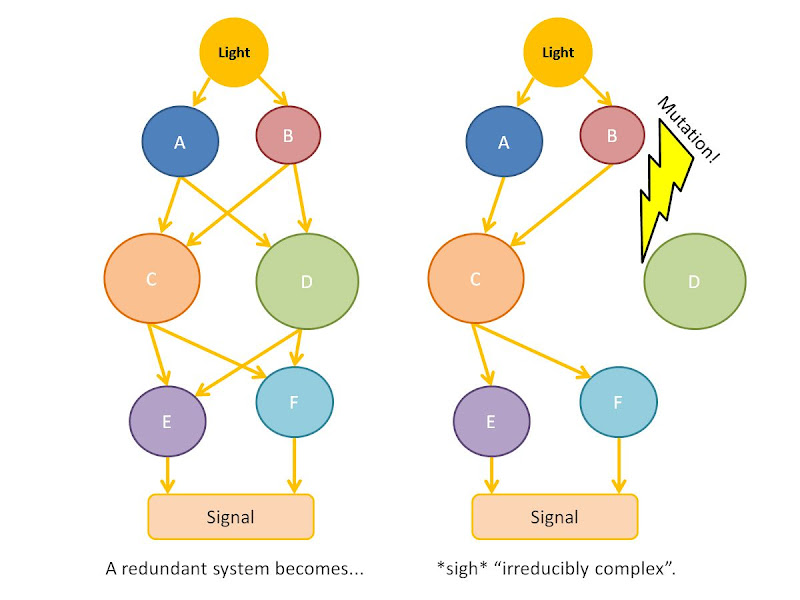
The remaining two of Behe’s assertions can be refuted together. Whether we actually observe irreducible complexity in organisms and whether such systems could have arisen by a process of evolution go hand in hand. By definition, if we can imagine a means by which an irreducibly complex system could have arisen by evolution, then it is not in fact irreducibly complex. This is actually quite easy to show, and gives me a chance to crack the flow charts again! Let us imagine a simple “reducibly complex” protein cascade, in other words one which has redundancy. A “signal”, such as light, enters the system and can be picked up by protein A or B. These proteins can then interact with either of another two proteins C and D, which all may interact with more proteins further along the signal chain. Here then, is a fully redundant system which could easily have evolved by totally conventional means. We need to make only one change in order to create one of Behe’s “irreducibly complex” cascades. We delete A, B, C or D. So let’s take D out of the cascade. In nature, this could easily occur as a result of a mutation resulting in either a loss of function or a change of function. If we get the second case, a change in function (and one that is beneficial in its own respect) then successive mutations will make it difficult for us to connect the new protein to its historical role in the old cascade. Behe will see that cascade as being irreducibly complex, but that is an illusion created by evolution. The cascade is merely “complex”.


Such plausible evolutionary histories have now been demonstrated for most of Behe’s major examples of irreducible complexity, including both the sight cascade and the clotting cascade. Indeed, in the latter case, proteins that Behe claimed to be critical to certain cascades have been demonstrated to be absent in other species, with no ill effect. We can even see backup systems in these species which are related to systems in humans that have now been diverted towards alternate functions. Whilst the evolution of many cascades has not been fully explored, this does not for a moment suggest that irreducible complexity exists in organisms, since at the very least the simple method I’ve outlined allows the illusion of these to emerge by evolution. So, do we see irreducibly complex systems in organism? Nope, just the illusion of them.

Triplethink

So where does this leave ID creationism? In an awkward position really. Irreducible complexity, if we assume it to be real (and deliberate), represents a significant set of design flaws. These flaws are compounded by the Designer’s perplexing choice of a DNA-based inheritance system that is so very prone to replication errors. This then, gives us not an intelligent designer, but a being who is, frankly, a bit of a moron. I’m not saying I could do better, but nor am I claiming to be an intelligent designer. In some debates with creationists, I have seen this argument countered with the suggestion that the lack of redundancy in some systems is the result of the “degeneration” of the creator’s perfect design, due to the Fall of Man. By that logic, all life must have been created fully redundant, or at least with key systems featuring back-ups. These were then lost due to mutation, resulting in the very same systems that creationists now claim represent evidence of design. So this thinking would force creationists to abandon irreducible complexity as evidence of design. In reaction to that annoying point, others still contend that life was created “perfect”, in an entirely different way, in that it was entirely irreducibly complex throughout and that the redundancies which exist are some manner of reaction to the expulsion of life from that “perfect” first environment. By this of course they are referring once again to the expulsion of life from Eden. This though, demands that the creator must either have intervened to modify his creation (which is not supported by their literal interpretations of Genesis) or, and this is the part which really upsets creationists, we must have gained some functional back-ups by mutation; a process they need to claim is impossible in order to discredit evolution.

By bringing irreducible complexity to the table in the great creation versus evolution debate, the ID proponents actually force themselves into trap. If they will not accept evolution (or at least some other alternative to creationism) then they must accept one of three things; that the Designer is fallible, that irreducible complexity is not evidence of design, or that mutation can generate new functionality. Oops.


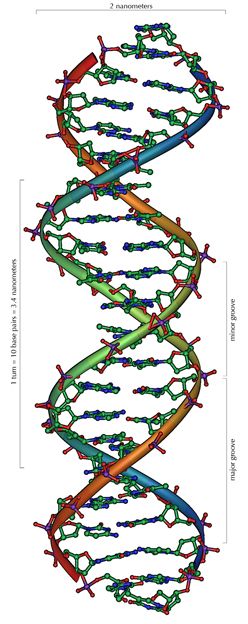
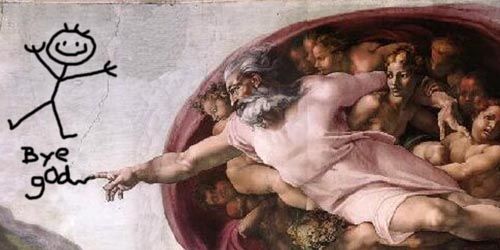
Image credits: DNA double helix by Michael Ströck. Released under the GFDL. Flow chart by the author. Creation of Adam by Michaelangelo. Public domain.

Tuesday, 26 August 2008

You Are What You Code

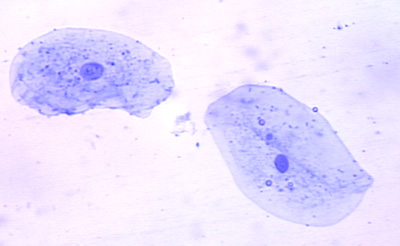
If you take a cotton swab and scrape it along the inside of your cheek, you can dab the soggy end onto a glass slide, put a drop of blue stain on it and, under a microscope, see the very building blocks of what you are. The average person is pretty unlikely to get hold of a microscope. So in some ways, you’ll have to take what I write here on the basis of some kind of authority, safe in the knowledge that you can test it yourself, at least in principle. Let’s imagine you’ve done it so. What you’ll see down that eyepiece will look something like the picture I’ve provided, a strange blob with a distinctive dark dot somewhere inside it.

This is one of your cheek cells. Cells are the units that make up our bodies. Each of us is composed of about 100 trillion of these units. That’s means that there are about 10,000 times more cells in your body than there are people in the world. Break down those cells into their component parts and you get the same stuff that everything around us is made of. Loads of water firstly. Then carbon, which we see in diamonds and in the black stuff in pencils. There’s also loads of oxygen, hydrogen, nitrogen and even metals such as iron. These are quite literally the very same substances which make up the atmosphere, landscape and the everyday objects we see around us. The iron in your frying pan is no different to the iron in your blood. One is a solid lump; the other is in tiny microscopic pieces.

The DNA Blueprint

Cells are themselves very complicated structures, though we can’t see much detail through our microscope. They come together to form the structures of our body. Our muscles formed from muscle cells, our skin from skin cells, even our bones are formed from cells which eventually become solidified. It’s hard for many people to imagine how all of this non-living stuff can come together to form a person. The secret to all of this lies in that dark dot inside the cell. We’re going to need a bigger microscope.


That blob is called the nucleus. We can imagine it as being the brain of the cell, though of course it is not aware of itself in any way. If we tease the nucleus open and look inside, we get lots of protein and water. And we get 46 strange little bundles of carbon, nitrogen, hydrogen and oxygen. These are our chromosomes, within which the carbon and its friends are combined to make that most fabled of compounds; DNA. That stands for deoxyribonucleic acid. I’m not even 100% sure what that means incidentally, but trust me we’ll get by.


If we could somehow take a hold of one of those chromosomes and tug it apart, we’d find that this DNA isn’t a blob at all, but a single long string wound around itself and bundled up countless times. And if we look closer still, we find that the strand is composed of repeating patterns. Each unit of that pattern is called a nucleotide. There are four different nucleotides and each is given a letter to represent it. a, c, t and g. When we read off a given bit of our DNA, we can write it down something like this:

acactcgcttctggaacgtctgaggttatcaataagctcctagtccagacgccatgggt

Imagine that going on for roughly another three billion letters, that’s how long human DNA is, if you count all 46 chromosomes. Looking at that all day will really make your eyes sore. I have great admiration for those patient, or perhaps mildly crazy geneticists.

What does this pattern of letters actually mean? It’s a blueprint for you. The pattern is identical inside the nucleus of every cell in your body. After all, your cells were all copied from that one first cell created when you were conceived. Whether it’s in a muscle cell or a cheek cell, all that changes is which bits of the blueprint the cell reads. The way it reads them is really quite ingenious too.


The Code


Our DNA directs the way we are built. If we take cells from just one part of our body, we’ll find that they have exactly the same DNA code as every other cell, down to the last letter. But unlike the others, the cells usually use or “express” a part of that code which the others ignore. Some parts of the code are used by every cell we have, but many are unique to some part of us. When a piece of DNA is expressed, the cell makes a copy of that piece out of a similar substance called RNA. RNA too is a strand composed of four letters, but is only a copy of the specific part of the DNA that this cell is interested in. Once it is made, the RNA “message” travels right out of the nucleus of the cell and is captured by tiny structures floating around outside. The RNA message is spooled through these structures which read the message and spool out a protein. Proteins, just like DNA, are long strands. However, proteins are made up of an entirely different set of letters to our DNA. There are 20 protein letters, and although they look a lot like DNA letters, they’re quite distinct. A protein sequence looks a bit like this when we write it out:

MVHLTPEEKSAVTALWGKVNVDEVGGEALGRLLVVYPWTQRFFESFGDLSTPDAVMGN

It looks meaningless, but it is a translation of the message sent by our DNA. The message is read in groups of three letters. Every three RNA letters corresponds to one of the 20 protein letters. So for example, the message “aag” gives us a K. “agc” gives us an S. It’s a code.


As the new protein created, it starts to wind up, tangle, knot and generally form a blob, but with a shape that is the same every time that same protein is made. This is because, as well as sticking together end-to-end in a line, some of the protein letters also like to stick together sideways. What happens next depends on what protein has just been built. Keratin, for example is one of the proteins unique to our hair follicle cells and our nails. To make hair, the keratin protein is moved to the outside of the cell where it begins to harden. DNA is transcribed to RNA messages. RNA messages are translated into proteins. And proteins can do almost anything. Some, like keratin, are exported from the cell where they may serve to build structures or alternatively to send signals to other cells. Others, called enzymes, make new substances themselves such as fats and sugars. Still others stick around inside the cell to help the cell function, perhaps building new parts for the cell or deciding which pieces of the DNA code the cell will express and when. Some proteins will even add metals to themselves. Iron, for example, makes up a part of the haemoglobin protein in blood, capturing oxygen to bring it all around our body.

Any part of our DNA which codes for a protein is called a gene. Some are expressed constantly, others in response to information and, as I said before, many will only express when the cell is in the correct part of our body. So muscle cells make strong muscle fibres, our eye cells make amazing proteins that can detect light and our immune cells make lethal poisons to kill invaders. We each have over 40,000 genes, but because of the ways that the genes can interact with each other through the actions of proteins, the actual number of proteins those 40,000 genes can make is much, much greater. Since many of those proteins can combine together or make new substances, it’s easy to see where our complexity comes from. And all of this comes from that one identical blueprint, at the core of every cell, expressed in different ways. Of course what you are is also modified by your environment. Diet, exercise and countless other influences change your body. Memories reshape your brain. That’s really a whole other story. But it all starts with the code. It’s pretty astounding what each of us can do with just four letters.