Showing posts with label hypothesis. Show all posts

Tuesday, 2 December 2008

Hypothesis, theory and fact: First Assumptions Part 2

I said I'd write something about conferences and fashionable science, but it didn't come. Until it does, here's something else I'm toying with.

"All perception of truth is the detection of an analogy." -Thoreau

In my first post to this blog I discussed the meaning of the scientific concepts of hypothesis and theory. I highlighted how the public tend to think of “theory” in the same way that scientists think of hypothesis, in other words as an idea or educated guess. In fact theory is a word we use to describe the scientific models that we have the utmost confidence in. I’d like to elaborate a little on the concepts of hypothesis and theory and how they relate to what we call reality or fact.

All of science begins with observation. We sample the world and derive data from it. We can make data from all sorts of measurements, indeed from literally anything we can observe and measure. We might be measuring the height of people, the amount of heat produced by chemical reactions or counting the number of bacteria on people’s coffee mugs.

Analogy time

Let’s consider a simplified and slightly unrealistic analogy. First, we’ll pretend that we know very little about the subject of the study we’re about to do; people. Perhaps we’re aliens (or just really antisocial) but we don’t know much about people and we want to find out more. We’re most interested in the relationship between the size of people and how old they are. So we plan to measure the height of people and their age and plot this data on a graph called a scatter plot. Every person we measure appears as a blue dot. The higher up the graph they are, the taller we’ve measured them to be. The older they are, the further to the right they’ll be.
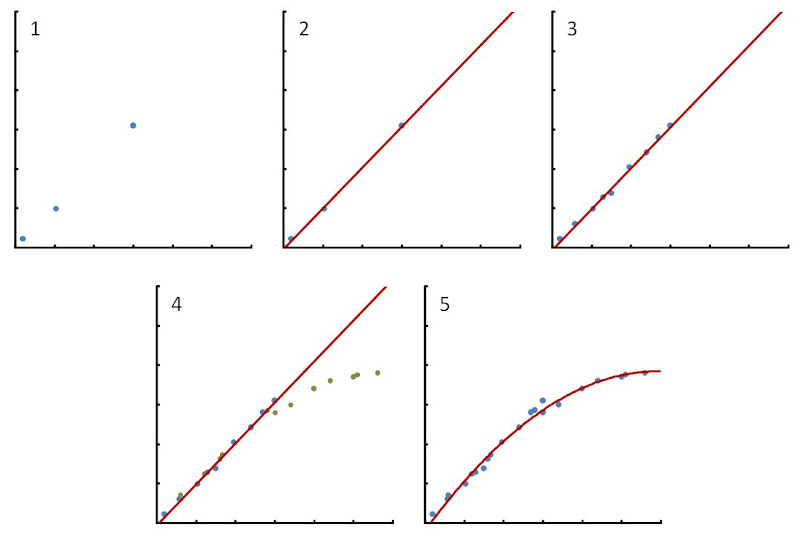


When we first begin to measure a thing, it can be difficult for us to determine if there are any patterns in the data, any meaning to be found. Look at graph 1. We antisocial scientists have made our first few measurements. Although it is far too soon to be confident that there’s a pattern here, it looks a bit like there’s a relationship between height and age in humans.

So we can create our first hypothesis. In graph number 2, we create a line which joins the data points together and also projects beyond them. We’re assuming that the relationship will hold for all people we measure, just for the moment. Just to make it sound important, we call our new hypothesis the Linear Growth Model or LGM (scientists love acronyms). The line is the hypothesis, a provisional model that we’ll cautiously use as a starting point. Put into words, the hypothesis would state: there is a linear relationship between the height of people and their ages. A statement of fact that we can now test.

The LGM is a good scientific hypothesis for that one important reason; it makes predictions that we can test. If the Linear Growth hypothesis is correct, then we expect that when we make more observations, they’ll appear on or near to our line. The scientific philosopher Karl Popper considered one other feature to be essential for a hypothesis to be valid; falsifiability, the possibility that our hypothesis can be shown to be incorrect by testing. At this early stage, our hypothesis could be falsified by finding just a few data points that fall far from out trend line. So of course we further test our model, measuring more heights and more ages. And when we look at graph 3, it seems we’re on to something! At this point it’s worth mentioning error. Measurements may often be subject to error. When measuring height, we might make a mistake. Or the height for people of the same age may vary (we know that it does of course, but for the purposes of our analogy let’s play dumb). So we often make the same measurement numerous times, or test many people of the same age. What we’ve done is measure our uncertainty and we can represent that uncertainty by drawing error bars that come out of each data point. We won’t worry about this further, but the point is that even though our data points may not exactly land on the red line, we are satisfied as long as the line passes through the area of error that lies around the data point.

With more and more data collected, our imaginary scientific colleagues now accept the Linear Growth Model as a satisfactory and useful model. It has become the Theory of Linear Growth. However, as often happens in science, it turns out that our theory is not entirely accurate. We realise that we’ve been building our model, the line, based on a very narrow data set. Because if you recall, we’re not all that familiar with how people work. And what we’ve gone and done is only measure the humans hanging around a playground. Some bright spark twigs that humans have loads of other habitats we didn’t observe. But maybe it’ll be okay, let’s find out. If the theory of Linear Growth is universally correct, then any new data points we get should continue to fit on our line. Of course we can see where this is going now, but let’s play dumb and continue.

When we extend our observations to older and older people, we start to see some data points that don’t fit our model at all. Had we seen these first few contradictory data points back at the start, it might have immediately caused us to discard our hypothesis before it even became theory. But with so much data in support of the theory, a few pieces of data are not sufficient for us to throw out the Linear Growth theory at the drop of a hat. As the saying goes, extraordinary claims require extraordinary evidence. But as we make more observations, the evidence becomes more compelling. In graph 4 it finally becomes clear to us that our theory has been falsified by the new data points shown in green. Too much of that data does not fit our model and thus we can no longer say that it represents fact.

Revolution!

So it turns out our old model doesn’t really work. But all is not lost. With our new data we can create firstly a new hypothesis and, in time, a new theory. In graph number 5 we see a curved red line that is the new Growth Plateau Model, a more comprehensive development of the now discarded Linear Growth Model. And so the old theory must be put aside- it serves as a model for the growth of children but is not useful outside of that context.

Our brand new Growth Plateau Model is testable and it has predictive power. We’re not concerned about gaps between the data points, because gaps do not falsify a model- contradictory data does. Were we to find many data points far from our line, we’d know our model was not accurate, assuming this was not explainable by some other means. But as the data keeps coming in, we find that the model holds for every observation.

Of course, hypothesis and theory aren’t strictly about scatter plots and trend lines. But this serves well as an analogy for how the process really works in science. Real hypotheses may be just as simple as that single statement about the linear relationship between aging and height. Theories however, are typically built from the combination of many hypotheses and unlike our analogy; they must not only have predictive power but also have explanatory power. We must be able to test the mechanisms that underlie the relationships we’ve modelled. But that concept of modelling reality, of joining the dots between our observations and testing that model, is fundamental to science. Just as fundamental is the moment we falsify our model and thus discard it. It is this moment, in which we build a new model upon the data, which sets science apart from dogma, in which no change is permissible, and diagnosis, in which we attempt to fit the data to various pre-determined models. Sometimes, as we saw with the Linear Growth Model, we don’t need to discard the old model, as in essence it becomes a small part of a bigger model and can still be useful in a limited way. In real science we can see many examples of this sort of “re-framing” of a theory rather than outright scientific revolution. For instance, although we’ve since come to understand modern genetics, the processes of variation and natural selection explained by Darwin are still a part of the modern theory of evolution. Similarly, the rise of Einstein highlighted the shortcomings of the Newtonian explanation of gravity, but we still use Newton’s laws for many simple applications. These theories, and indeed all good theories, share the predictive power of our made-up theory. Evolutionary theory allows us to predict what we’ll find in the fossil record and the genetic codes of organisms, and provides an explanation for those findings. To date, it has not failed us in either regard. Relativity explained peculiarities in the orbit of the planet Mercury and predicted strange effects of high speed upon the flow of time that would later be observed in experiments. So we can have great confidence that the untested predictions of these theories are accurate, that our models represent fact.

Sunday, 9 November 2008

What's the Storey?

This week, due to finding myself very busy, I haven't had a chance to write my usual (vaguely) weekly blog. I did manage to write a letter to the Irish Times newspaper after being rather incensed by the comments of Northern Irish politician Cllr. Mervyn Storey. Since it has been a week and I'm very impatient, I decided to post it here. Cllr. Storey, it seems, would like to bring creationism to European shores. He would also prefer to see the theory of evolution removed from sylabbuses in Northern Ireland, but seems to have a fairly hazey notion of what it is he wants rid of. His poorly-researched thoughts on the matter may be read here. My general thoughts on evolution and creationism can be read elsewhere on this blog.

Madam,

Mervyn Storey (Opinion and Analysis, November 3rd) describes a scientific theory called "naturalistic evolution" in his argument for the teaching of creationism in Northern Irish schools. "The central, core belief of naturalistic evolution", Storey claims, "is that somewhere in the universe at some time in the far distant past, non-living matter of itself, with no outside influence or mind to guide it, gave rise to living creatures." As a biology research student, I must confess to having never heard of the theory of naturalistic evolution. However, on examination of Storey's description, I find that it summarises the hypotheses on a process called abiogenesis, the emergence of life from non-living matter. A hypothesis is a candidate theory, not yet accepted by the scientific community as a model or representation of reality. With regard to abiogenesis, there are several of these hypotheses, but no accepted theory. Biochemists know of many plausible means by which simple life might emerge by materialistic means, but whether any of these actually occurred is very much an open question. Mr. Storey might well delight at such an admission from a biologist, however I should point out that abiogenesis is not in fact an element of the theory of evolution. Rather, evolution is a theory which explains the emergence of the many varied species from a single common ancestor species, and does not address the first emergence of the first life from lifelessness. This is why Darwin's 1859 work describing evolution was entitled "The Origin of Species" and not "The Origin of Life". Whether that single-celled Adam or Eve emerged by abiogenesis, fell from the sky or was sculpted from clay by the hands of the Creator is largely irrelevant to the veracity of the theory of evolution.

It is troubling that Mr. Storey is either ignorant of the theory he is attacking, or has knowingly constructed a straw man in this "naturalistic evolution" concept that no scientist accepts as fact or teaches as fact. Such ignorance and misrepresentation are common tools of the American creationist movement, and it is most saddening to see such stock anti-scientific rhetoric finding receptive minds on our shores. It is also very worrying that such a flimsy argument is being used to promote what Mr. Storey must consider to be the automatic alternative to evolution. He is presenting us with the same old false dichotomy; that if evolution is false, creationism is true. The veracity of evolution relies on evidence; creationism, to judge from Mr. Storey's argument, on the falseness of evolution.

Tuesday, 21 October 2008

Moronic Design

November of next year brings to us biology-types, and to all of the scientifically-minded, a very special anniversary. It will mark the 150th year since the publication of what is certainly the most significant scientific work in the field of biology and one which would easily make the top three across the entirety of science. The publication in question is of course Charles Darwin’s “On the Origin of Species”. In it, Darwin laid out his case for his hypothesis on, as the title suggests, the origins of the variety (and similarity) we see between the many species of our planet.

The theory states the following. A common ancestor species once existed which produced offspring. As new generations of offspring were produced, inheritable differences (variations) began to appear in them. Some variations produced a benefit, others did not. Those variations that were beneficial enhanced the survival of the altered offspring and so those new traits were more likely to be passed on. The detrimental variations, whilst not always fatal, were less likely to be passed on simply because they reduced the carriers’ chances of survival and reproduction. Thus we have three simple mechanisms; reproduction, variation and selection. Add enough time, changing environments, migrations, separations and countless other influences and you get groups of organisms that have changed so much that they can no longer interbreed. These are broadly called species. So when you have these mechanisms working across an entire planet for over 3 billion years, you get a whole lot of species. I covered this whole process in a whimsical little story, posted a couple of months ago.

The scientific crisis and revolution that followed lasted decades, and was mostly heralded by Darwin’s supporters, rather than the man himself. His book and the works which confirmed his observations made a compelling case, and 150 years later his theory of evolution is accepted as the standing model of how life on Earth derived from a common ancestor. It is a theory that is so simple to explain that it is often described by scientists of all fields as “elegant” or even “beautiful”.

You may recall my explanation of how scientists develop a hypothesis, a testable idea, and then make observations and measurements that have the potential to disprove the hypothesis. If the hypothesis survives many observations, can be shown to predict bits we haven’t looked at yet, and can be confirmed independently, it becomes theory. A theory is the currently accepted model. That’s an important definition, because in common language “theory” generally has a meaning more like what scientists call a “hypothesis”. So when say, a creationist calls evolution “just a theory”, they are being rather misleading. Evolution (the process) is a fact and the model of that fact (the theory of evolution) is accepted by the vast majority of scientists as being entirely valid. So, more accurately, the theory of evolution is “just a (robust) theory (that has been re-tested and confirmed countless times over the course of 150 years and is now accepted as entirely valid by greater than 95% of scientists and greater than 99% of biologists”. Phew. I can see why they shorten it.

The metaphor-free zone

What I’m trying to get across is that evolution is a theory, in other words a model of reality, which is as well-accepted by scientists as Einstein’s theories of relativity. It’s important to remember that when considering the arguments of those who would tell you that evolution did not happen. I will generically refer to these movements as creationism, though that will certainly annoy them. Their common element is that they ascribe the creation of the Earth and of all life to a supernatural intelligence. In most variants this is the Christian God, and the basis of their “theory” is a fully literal interpretation of the book of Genesis. No, symbolism, no metaphor. A literal six day creation of the universe and all life in it.

There’s insufficient space here (and I have insufficient time) to fully explore the evolution versus creationism debate, but I would invite readers to visit TalkOrigins or explore various internet debates on the matter to get a feel for how in-depth the row has become over the past few decades. Leave your sanity at the door, it will only hinder you. Rather than delve into that whole mess, I will instead focus on the core issue that is used by one branch of creationists; the “intelligent design” (ID) proponents. ID proponents believe that life was designed by a great intelligence. They are unspecific as to the age of the Earth (traditional creationists put the limit at around 10,000 years) but believe that life was created in a single creation event and has varied only within tight boundaries since then. They also contend, as do most creationists, that mutation (the process that causes the variation in evolution) cannot create new function, but rather can only break the function of a gene or restore its previous function. Officially, they do not identify the intelligent designer as “God”, but internal documents leaked from the ID inner circle reveal that they are in fact Christian creationists with a secular gloss over them. This is apparently to make their ideas appear more palatable to institutions such as the secular US education system into which they would like to insert their “science”. So we can quite confidently label intelligent design as creationism.

If ID constitutes science then it must have a testable hypothesis at its core. Evolution states as its core hypothesis that all life derived from a common ancestor by variation and selection. That statement has many implications which we may test. We should, for example, be able to find evidence of organisms, perhaps extinct, which show a transition between known species. Evolution thus makes a prediction that we ought to be able to find such species in the fossil record. And we do. What does ID predict? Not much. If life is entirely designed by a creator with only one specified trait (intelligence), it could look like almost anything at any level. It could even be made to look entirely as though it evolved. It’s thus rather unsurprising that creationists in generally spend most of their time trying to discredit evolution rather than testing things such as ID. They propose a false dichotomy (a made-up two way choice); if evolution is false, creationism must be true. All other imaginable or unimaginable options are somehow off the table.

Scientism

In their flailing attempt to make ID into a science, its proponents latched onto the work of ID defender Michael Behe who suggested in his 1996 book Darwin’s Black Box that intelligent design was proven plausible by the existence of what he termed “irreducible complexity” in biological systems. Irreducible complexity, according to Behe, is a property of any system which performs a function but which is disabled entirely if we remove any critical part of that system. Thus, a clockwork pocket watch would be considered irreducibly complex, as removing a cog will cause the watch to stop functioning as intended. Behe firstly contends that this is a property we expect to see in any intelligently designed system and secondly that the property is observable in life forms. He also claims that such systems cannot arise by evolution, since the various parts would have to evolve at the very same time and this is improbable. I will now attack all three assertions.

In the first instance, Behe is essentially claiming that irreducible complexity is a testable implication of the ID hypothesis, much as we can say that transitional fossils and genetic similarity (we share common DNA with all known life forms discovered to date) are testable implications of the evolution hypothesis. This is logically flawed in many respects. Firstly, in the design of various mechanisms, a human designer must consider a number of factors that will determine the amount of redundancy (or back-up systems, if you like) that a mechanism will have. The intended life time of the mechanism, the replacement cost of it and the practicality of repairing the object will all feed into that decision. A pocket watch can be repaired, as can a car. We’ll certainly build in some backup systems here and there, but where that isn’t practical, or essential, we’ll leave a number of critical systems in our design. Thus the pocket watch and the car become, “irreducibly complex”. By assuming that this feature is something we expect to see in designed life, we are making a rather significant assumption about the intention of the designer. We are assuming that the design considerations for an organism are in some manner similar to those for a mechanism such as a car or pocket watch. However, in a system that is difficult to repair (without modern medicine; a recent development), intended to last decades without maintenance and prone to replication errors (DNA mutation), do we really want to have critical systems with no backup? More to the point, if we assume that we do want such dangerous breaking points built into an organism, wouldn’t it make sense to build redundancy into the most important systems? Let’s consider some of the systems that Behe claims display this lack of redundancy in humans; the blood clotting cascade and the sight cascade. A biochemical cascade is a system in which a protein is affected by something (for example, light from our eye) and reacts by signalling another protein, which signals another and so forth until that signal is propagated to our brains. So we can see in the clotting cascade and the sight cascade that non-redundant points exist. Mutate specific proteins and the cascade breaks like the pocket watch. The sight and clotting cascades are extremely important systems for our survival and yet for some reason, redundancy exists in other, less (or equally) important biochemical systems. The chemokine system that controls the communication between our immune cells has multiple backup levels built into it, for example. We are thus forced to conclude that whether irreducible complexity is an expected feature of designed life depends heavily on the capabilities, level of intelligence, desires and intentions of the designer. If we assume that humans were directly designed, we are also forced to conclude that the designer is either technically limited, rather dim, malevolent or disinterested in individual human survival. Or a combinations of these traits. If we assume that our designer is actually fully “omnipotent”, we actually cannot make any assertion at all about what features we’d expect to see in designed life, since that designer could make life appear any way it chose without consequence.

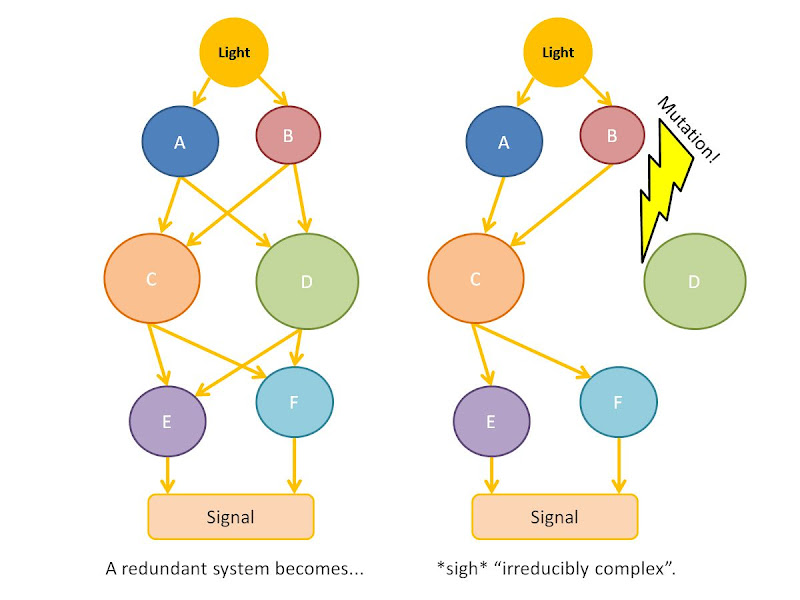
The remaining two of Behe’s assertions can be refuted together. Whether we actually observe irreducible complexity in organisms and whether such systems could have arisen by a process of evolution go hand in hand. By definition, if we can imagine a means by which an irreducibly complex system could have arisen by evolution, then it is not in fact irreducibly complex. This is actually quite easy to show, and gives me a chance to crack the flow charts again! Let us imagine a simple “reducibly complex” protein cascade, in other words one which has redundancy. A “signal”, such as light, enters the system and can be picked up by protein A or B. These proteins can then interact with either of another two proteins C and D, which all may interact with more proteins further along the signal chain. Here then, is a fully redundant system which could easily have evolved by totally conventional means. We need to make only one change in order to create one of Behe’s “irreducibly complex” cascades. We delete A, B, C or D. So let’s take D out of the cascade. In nature, this could easily occur as a result of a mutation resulting in either a loss of function or a change of function. If we get the second case, a change in function (and one that is beneficial in its own respect) then successive mutations will make it difficult for us to connect the new protein to its historical role in the old cascade. Behe will see that cascade as being irreducibly complex, but that is an illusion created by evolution. The cascade is merely “complex”.


Such plausible evolutionary histories have now been demonstrated for most of Behe’s major examples of irreducible complexity, including both the sight cascade and the clotting cascade. Indeed, in the latter case, proteins that Behe claimed to be critical to certain cascades have been demonstrated to be absent in other species, with no ill effect. We can even see backup systems in these species which are related to systems in humans that have now been diverted towards alternate functions. Whilst the evolution of many cascades has not been fully explored, this does not for a moment suggest that irreducible complexity exists in organisms, since at the very least the simple method I’ve outlined allows the illusion of these to emerge by evolution. So, do we see irreducibly complex systems in organism? Nope, just the illusion of them.

Triplethink

So where does this leave ID creationism? In an awkward position really. Irreducible complexity, if we assume it to be real (and deliberate), represents a significant set of design flaws. These flaws are compounded by the Designer’s perplexing choice of a DNA-based inheritance system that is so very prone to replication errors. This then, gives us not an intelligent designer, but a being who is, frankly, a bit of a moron. I’m not saying I could do better, but nor am I claiming to be an intelligent designer. In some debates with creationists, I have seen this argument countered with the suggestion that the lack of redundancy in some systems is the result of the “degeneration” of the creator’s perfect design, due to the Fall of Man. By that logic, all life must have been created fully redundant, or at least with key systems featuring back-ups. These were then lost due to mutation, resulting in the very same systems that creationists now claim represent evidence of design. So this thinking would force creationists to abandon irreducible complexity as evidence of design. In reaction to that annoying point, others still contend that life was created “perfect”, in an entirely different way, in that it was entirely irreducibly complex throughout and that the redundancies which exist are some manner of reaction to the expulsion of life from that “perfect” first environment. By this of course they are referring once again to the expulsion of life from Eden. This though, demands that the creator must either have intervened to modify his creation (which is not supported by their literal interpretations of Genesis) or, and this is the part which really upsets creationists, we must have gained some functional back-ups by mutation; a process they need to claim is impossible in order to discredit evolution.

By bringing irreducible complexity to the table in the great creation versus evolution debate, the ID proponents actually force themselves into trap. If they will not accept evolution (or at least some other alternative to creationism) then they must accept one of three things; that the Designer is fallible, that irreducible complexity is not evidence of design, or that mutation can generate new functionality. Oops.


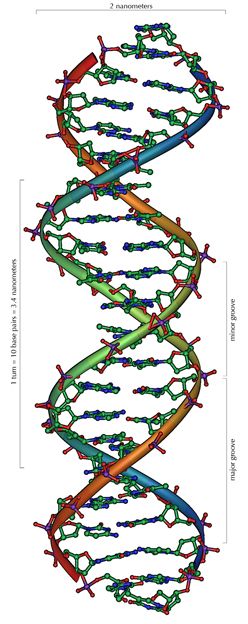
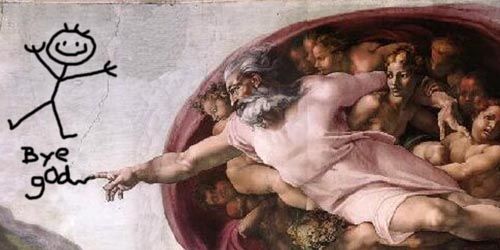
Image credits: DNA double helix by Michael Ströck. Released under the GFDL. Flow chart by the author. Creation of Adam by Michaelangelo. Public domain.

Thursday, 25 September 2008

Fear and Vaccination in London

Author's note: After my successful foray into soapboxing with the LHC story, I decided to get back up on the box again to trumpet my current hypothesis. Science, the scientific method and scepticism are misunderstood by almost everyone and something has to be done. For more evidence of just how bad things are, check out the ongoing research into the dangers of dihydrogen monoxide. The research itself is satire (sorry to spoil the fun, but I certainly don't want people to think I don't get it). The reactions of the public are the really frighetning part. Anyway, on to the self-righteous ranting.

In 1998 a British-based surgeon, Dr. Andrew Wakefield published a research paper in which he and his team tentatively identified a bowel disorder associated with autism which he coined “autistic enterocolitis” and speculated (a very important word there) that this might be caused by vaccination with the MMR vaccine. Most people are roughly aware of what MMR is. The measles, mumps and rubella triple vaccine. It is a mixture of the three viruses, alive but weakened to the point that they’re not even able to infect infants. They do however cause the recipient’s immune system to generate lots of cells and antibodies that will basically squash the three viruses should they ever be seen again. The need for vaccination against these three diseases is an easy case to make. Measles in adults can cause brain damage. Mumps may cause infertility in males, especially kids. Rubella, if it infects the unborn through the mother, can cause a wide range of birth defects. These complications don’t occur often- but the viruses are so infectious that those rare cases would be a big deal in any highly populated country.

Cause and Effect

So MMR was suggested to have an influence on autistic intestinal inflammation, but there was more. According to Wakefield’s paper, there also appeared to be a connection between the time of administration of MMR to a child and emergence of autism, though that element of the study was retrospective. The paper itself did not rock the boat in the mainstream media, th
ough the scientific community began criticising it immediately. The connection between MMR and autism was not clear, and the study group was small. Just twelve children, all selected because they had autism. At best, that sort of study would represent a starting point for some more solid research. To be meaningful and to make that connection really clear we’d need thousands of examples, and we’d to be able to compare our results with loads of non-autistic kids.

It wasn’t until Wakefield decided to jump outside of the peer-review system that things began to go bad. I discussed in a previous posting how science makes its way into the mainstream media. I even included a flow chart, which I’ll reproduce now. What Dr. Wakefield did was follow the path on the far right. Skipping all external controls and critique he instead decided to talk directly to the press. And what he had to say would cause a sensation. He called for a halt to administration of the MMR vaccine in favour of vaccinating for each of the three diseases separately over an extended time of several years. His stated reasoning was that he believed that MMR might be causing Autism. The initial response in the media was muted. The press release and an accompanying video released by Wakefield’s hospital drew some attention. Wakefield found himself defending his work in letters to the journal that had published his paper, Lancet. In 2000, Wakefield published more papers pushing his MMR hypothesis. Then in 2001, something snapped. Perhaps it was the publicity, the momentum built in the last couple of years. Perhaps Wakefield’s recent high-profile exit from his hospital position (a “mutual decision”) was noticed. Perhaps some of his new research papers pushed the right buttons. Whatever it was, the MMR and autism story hit the mainstream.

What Grows in Darkness

The newspapers went wild, particularly in the UK. By 2002, the stories in the press questioning the safety of MMR numbered in the thousands. Few dealt with the inconvenient peer-reviewed research papers that refuted Wakefield’s findings and the controversy dominated health reporting for several years. Here was a piece of news based on the (very carefully worded) concerns of a single surgeon. But somehow the line (in the Daily Mail at least) became “Scientists Fear MMR Link to Autism”. “One Scientist Cautiously and Inappropriately Suggests MMR Link to Autism” is not very catchy perhaps, but the fear mongering sentiment went further than headlines and permeated the reporting. As a direct result, MMR vaccination rates in the UK fell to 80% by 2003. In some urban areas of London, the rate was as low as 65%. When we learn a little about how vaccination works these, figures become even more alarming.

Vaccination is not 100% effective on a person-to-person basis, though it is usually above 99% effective. This is generally not an issue however, as vaccination also serves to protect the unvaccinated by eliminating the pool possible hosts for a given virus. Because your neighbours are all immune, your chances of even encountering the virus, let alone contracting it, are dramatically reduced. The virus is much less likely to be passed around by accident. This effect is called “herd immunity”. For the three viruses that MMR protects against, the threshold for good herd immunity is around 95% of the population. With the rate of uptake so low in 2005, the risk was rapidly increasing that herd immunity would collapse, resulting in large scale epidemics amongst the roughly 20% of unvaccinated children and the 1% for whom the vaccine had failed to take.

Predictably, the epidemics began around 2000, when the earliest signs of concern had begun to filter through to the public. Measles epidemics were reported in Ireland, Austria and Italy. Most significantly, measles incidences in the UK have increased steadily over the last eight years. Although the increase may appear minimal (from 56 cases per year in 1998 to an estimated 900 cases per year by 2006) the disease was declared “endemic” in the British population earlier this year. This means that the virus is now circulating freely in the population without need for re-infection from outside sources. So anyone without immunity is immediately at much greater risk. Herd immunity is degenerating. There is also evidence that travellers to and from Europe triggered minor outbreaks in the United States. Mumps is on the rise again also, primarily hitting age-groups who passed through infancy prior to the introduction of MMR. Some 70,000 cases were reported between 2004 and 2006. There were a handful of deaths as a result of the measles and mumps resurgences. Three deaths were reported in Ireland, one death in the UK and two cases of brain damage. Not many, but a reminder to us of times when these diseases were a true threat.

The degeneration of herd immunity is just the first step, there is another risk associated with allowing these viruses to become endemic. For every infected person there are literally billions of mumps, measles or rubella viruses in their system. The more viruses there are, the faster they reproduce. The faster they reproduce, the more often they mutate. With part of the population vaccinated and part not vaccinated, what we are doing is presenting the mutating viruses with an obstacle to overcome. The risk is growing that one of these three viruses may undergo the mutation required to evade MMR entirely.

In 2004, ten of Wakefield’s co-authors on the 1998 paper withdrew their support for the work. Since the first publication, at least twenty peer-reviewed research or review papers have discredited the MMR link to autism. Wakefield’s suggested new “autistic enterocolitis” has been dismissed by autism researchers as a common symptom of the condition. Ten years after the controversy began, MMR is not the only vaccine to fall victim to the resurgent paranoia and disillusionment with modern medicine, though this is a trend which predates the MMR scare. Some papers continue to lead a crusade against any proposals for new “multivalent” vaccines that, like MMR, would combine protection from several diseases.

Apportioning Blame

It was a need for a simple cause which ultimately brought the MMR crisis into being. But the fact is, there’s no known single cause for autism. And nor are the causes of the vaccination crisis as clear as they seem. It would be easy to point the finger at Dr. Wakefield. He’s certainly not free of blame. Wakefield’s 1998 study was prompted when he was approached by solicitors representing a group planning to sue MMR manufacturers for causing the autism. According to a Sunday Times report in 2006, Wakefield received money from that group to perform his 1998 study and it appears that some of the study participants were sourced by them too. It is also alleged that Wakefield’s hospital, who were quick to back his findings and arrange press contact, also received money in the form of legal aid. It seems clear from interviews at the time that Wakefield was aware of the fine balance of risks associated with his bold statement. He was aware that switching from the use of MMR to using three vaccines over a number of years very significantly increases a child’s risk of contracting one of the diseases in that time. Wakefield’s point was that the risk of autism outweighed both the fact that his results were unclear and the fact that his suggested course of action brought great risks. He should absolutely not have been going public with his poorly-conceived idea, yet his language in the press release and interviews was actually quite suitably cautious. The subtlety was lost on many news outlets. Rather than exhibit caution themselves, they perpetuated a fear-laden story that has done incalculable damage to public health in Europe. Many of these are the same papers that, years later, are now assassinating Wakefield’s character in light of professional misconduct charges. Ultimately we have to blame pretty much everybody; parents looking for simple answers, lawyers looking for litigation, a surgeon with a bias, a hospital looking for publicity, a media willing to spin anythi
ng to sell papers. Not to mention the confused reactions of most GPs and politicians (a blog in itself). And then there’s us. The scientists fought the good fight on the day, sure. But it could be argued that our aloofness from the public has created a culture in which science is only noticed when it is sensational; a culture in which the people have neither the education nor the inclination to view science with proper scepticism. It’s conceivable that just one of those groups had it in them to prevent this whole huge mess. Instead we are now facing continued vaccine paranoia and a dangerous resurgence of diseases we once had on the run.

Tuesday, 16 September 2008

Horsey

Author's Note: This week The Biologista is doing science and also going to a sciencey conference. Hence, the re-run of one of his favourite posts from way back when. That being July. He will return later this week with a brand new post about Vaccination and Fear.

Current speculative thinking is that the immune systems of many individuals co-evolved in the presence of persistent parasitic infestation. The immune system therefore evolved to over-compensate along the anti-parasite axis. It needed to be able to deal with new parasitic infection on top of the un-clearable persistent infection. We call this parasite killing axis the Th2 response. We can imagine our immune system as a sort of see-saw, but with many sides. As one side, or axis of our immune response raises, it pushes the others down. Some infections require a broad, balanced response. Others need a strong, single axis attack. Our persistent parasites evolved, adapting to evade our Th2 response. Some would push our immune response along other axes, perhaps towards our anti-bacterial response. The upshot of this was that we required further Th2 over-compensation. This co-evolution has probably been ongoing since our pre-mammalian ancestors. This is evolution over a time on the order of hundreds of millions of years.

Suddenly, in the space of a mere 200 years, the western world eliminated normal everyday parasitic infection. From an evolutionary point of view, an advantageous trait had become redundant in the blink of an eye. Individuals who previously had an evolutionary edge suddenly had a disadvantage.
The asthamtic, the hayfever sufferer and the general sneezy snot bag has an immune system that resembles a race horse suddenly lacking its burden. The jockey, that nasty little parasite, has fallen off. The horse is gleefully running for the finish line, thinking he is about to win.

This stands as a wonderful example of the importance of context in evolutionary traits and in the emergence of new mutations. Allergy is today seen as some sort of genetic "defect". In African countries where the parasitic trypanosome and schistosome problems are finally starting to be reduced, allergy is starting to emerge. Perhaps this is mere coincidence, but if our thinking is correct, allergy and asthma will increase considerably there over the coming years. That is of course assuming that the western world gets off its arse to help do something about health in Africa.

Tuesday, 12 August 2008

It's Revolution, Baby

Science is usually portrayed and imagined as one of two clichés. The scientific establishment is a vast panel of crusty old sceptics, dismissive of innovative thinking and ever willing to attack upstarts. On the flip side of this, “revolutionary” science is so frequently fanfared to the front pages of newspapers that we could almost believe that scientists are as excitable and credulous as the tabloids appear to be. Everyone loves a David and Goliath story, so it is hardly surprising that every controversial finding is pounced upon. Miracle cures and perpetual motion machines are all the more exciting when it appears that they show up those stuffy old boffins. Strange how the rebels and their miracles most often vanish without further updates. With so many contradictory findings being touted each week, it’s easy to see why so many people become disillusioned with science. Going by the newspapers, I’m still not sure if my coffee addiction is going to give me a stroke or save me from a heart attack. In my previous blog (Science Says) I talked about why I think this happens, and why it’s not actually a reflection on proper science at all. True scientific revolution is another story and an exciting one. Maybe not “tabloid exciting” though.

The best explanation as to How Breakthroughs Happen goes like this. A couple of years ago I was fortunate enough to work with a rare kind of scientist. The man, who we shall simply call Oz, is to my mind one of an elite subset of scientists who dedicate their careers to answering a single, if profound question. Oz is also something of a philosophy buff and introduced me to the scientific philosophies of Thomas Kuhn, a man who had a lot to say on the matter of scientific revolutions. On the small scale, science is a cyclical process, as I outlined in First Assumptions. Hypothesise, test, refine, repeat. In time, hypothesis becomes theory or a new part of an existing theory. We can call the prevailing set of theories the “standing model” as they represent a human modelling of reality as we see it. Conferences and the peer review process serves as a rigorous test of the output of the scientific cycle. Scientists are a competitive, aggressive bunch. Attack, until only the truth remains. This constitutes what Kuhn called “normal science”. An overall model, the standing theory is in place, and scientists are filling in the blanks. It is tough work and worthy work. But, as the normal science phase drags on, discrepancies begin to arise.

When Isaac Newton published his theory of universal gravitation in 1687, it represented a fundamental change in the scientific understanding of the universe. It was a true piece of revolutionary science that dismissed theories as old as Aristotle. Once it was put forward and accepted by the community, normal science proceeded. Newton’s theory remained the standing model for over 200 years as the universe was measured and scrutinized using newer and better technologies. The cracks began to show. The movements of some of the planets didn’t fit the theory. The effects of gravity on light didn’t seem to either. And there was more. As always happens, a few contradictory measurements will tend to be dismissed as errors. But as they mount up, efforts will be made to explain them away within the context of the current model. This may well resolve the situation, but for Newton’s legacy this did not suffice. The physics community had entered what Kuhn called a “crisis phase”. The standing theory was clearly inaccurate, yet no theory existed to replace it. New hypotheses were put forward, amongst them the notion that the universe was filled with some manner of “aether”.

In 1905, almost unnoticed, a patent office clerk called Albert Einstein suggested a few things that might help explain how light worked. He demonstrated his ideas via some nice publications which were pretty much entirely dismissed as being a bit strange. A few years later, with a PhD under his belt, Einstein went the whole hog and published General Relativity, a new model that explained pretty much everything that was inconsistent in the Newtonian model and blew the aether out the window. The new thinking was so fundamentally different to Newton’s view of the universe that there was considerable resistance to his new model. As with all new science, revolutionary or otherwise, it had to face the purifying fire of skepticism, particularly from the aether heads. It wasn’t until 1919 that the experimental confirmations finally started to emerge. Einstein’s hypothesis prevailed and within a few years the scientific crisis was resolved. Kuhn called this sort of changeover a “paradigm shift”. The information, the observations, they’re still the same. The understanding has changed. Although the more recent notions of the aether-filled universe was now dismissed, Newton’s theories were not abolished. Instead they became merely a small part of a much bigger picture. Used for simple calculations where Einstein’s equations would be overkill. And so, the task of filling in the blanks in the new model began. Normal science was resumed.

Whilst scientists are often painted as inflexible types sticking to their established knowledge and rejecting change, the reality is that this resistance to change is as valuable as the change itself. It ensures that only the most robust hypotheses become theory. We stuffy boffins are always aware that one day the theories that we hold to may be superseded just as Newton was or may be overturned completely. Almost 100 years later, General Relativity, with additions, is still the accepted model. Yet at the extreme ends of physics the cracks are showing once again. It is perhaps ironic that it was Einstein’s ideas regarding the nature of light that would lead to the birth of Quantum Theory, a model which may one day lead to the next great paradigm shift in physics. For those interested, read up on the Large Hadron Collider. This year it may just prove or disprove a huge chunk of Quantum Theory. I have only a vague idea how, mind you. Physics is witchcraft in my books.

Normal science, crisis, paradigm shift, repeat. It’s a pattern that gave birth to giants of science such as Theory of Evolution and the Galilean model, or such field-specific shifts as the discovery of adaptive immunity. Don’t worry, I’ll probably write about those ones some day. My point is that paradigm shifts may change an entire arm of science, such as Biology, or just a small corner of that arm. Dr. Oz is, to my mind, on his way to heralding a paradigm shift in Biology. He’s in one of those small corners of the field, but the implications of his work speak for themselves. He’s convinced me, at least. The information hasn’t changed, but the way I understand it will never be the same. Let the crisis begin.

Sunday, 27 July 2008

First assumptions

Beginnings are tricky. I feel like I should make a good impression. I've had a haircut and a shave. I'm wearing a trendy shirt and some sort of designer smell. I'm going to start at the beginning...

As infants, each of us begins to form what a scientist would call “hypotheses”. Most, less pedantic, people would call them “theories”. That word has another meaning for the scientist, but I’ll come back to that. A hypothesis is an idea, a position we assume based on some limited information. Amongst the first hypotheses that infants will form goes something along the lines of “stuff falls down”. The gleeful child will test this new idea by experimentation. Hence the wondrous phase during which the child will pick up any and all objects within reach simply to give them forcefully to the floor. The reproducibility of this experiment convinces the child that the hypothesis is good and the idea finally graduates to a loftier status, probably giving birth to a new hypothesis in the process; “parent-things get angry when I make stuff fall down”.

Scientists adopt a similar method. Starting with some previously-solidified information, they adopt a hypothesis. Just as a child will do, until the complexity of life leads them to question the world less, they adopt an initial position, for the sake of argument if you like. The scientist has faith in one notion alone, that the universe may be tested by observation. So, the one essential requirement for a hypothesis to be valid is that it must be testable. The philosopher Karl Popper advocated going one step further, stating that the only valid hypotheses are those that could be falsified, that could possibly be proven wrong. A good scientist conducts his experiments, his means to observe the universe, in order to do just that. He seeks to falsify his hypothesis.

It is only when repeated attempts to prove himself wrong have failed that the scientist comes to believe his hypothesis at last. And it is only when those observations have been attacked and reproduced by many others, by colleagues and competitors, that the scientific community accepts the hypothesis. It is then that hypothesis becomes “theory”. There is in truth no such thing as scientific fact, at least not in the sense that most people imagine. Instead, theory is the highest status to which our knowledge may ascend. That difference between what scientists call theory and what the common man calls theory is the reason why a scientist will never say “it’s just a theory”.